A note about links: If we include links to retail sites like Amazon or Bass Pro Shops, it's because they're relevant to the topic and, as anglers ourselves, we believe they're worth checking out. As an Amazon Associate we earn from qualifying purchases.
What just bit your line?
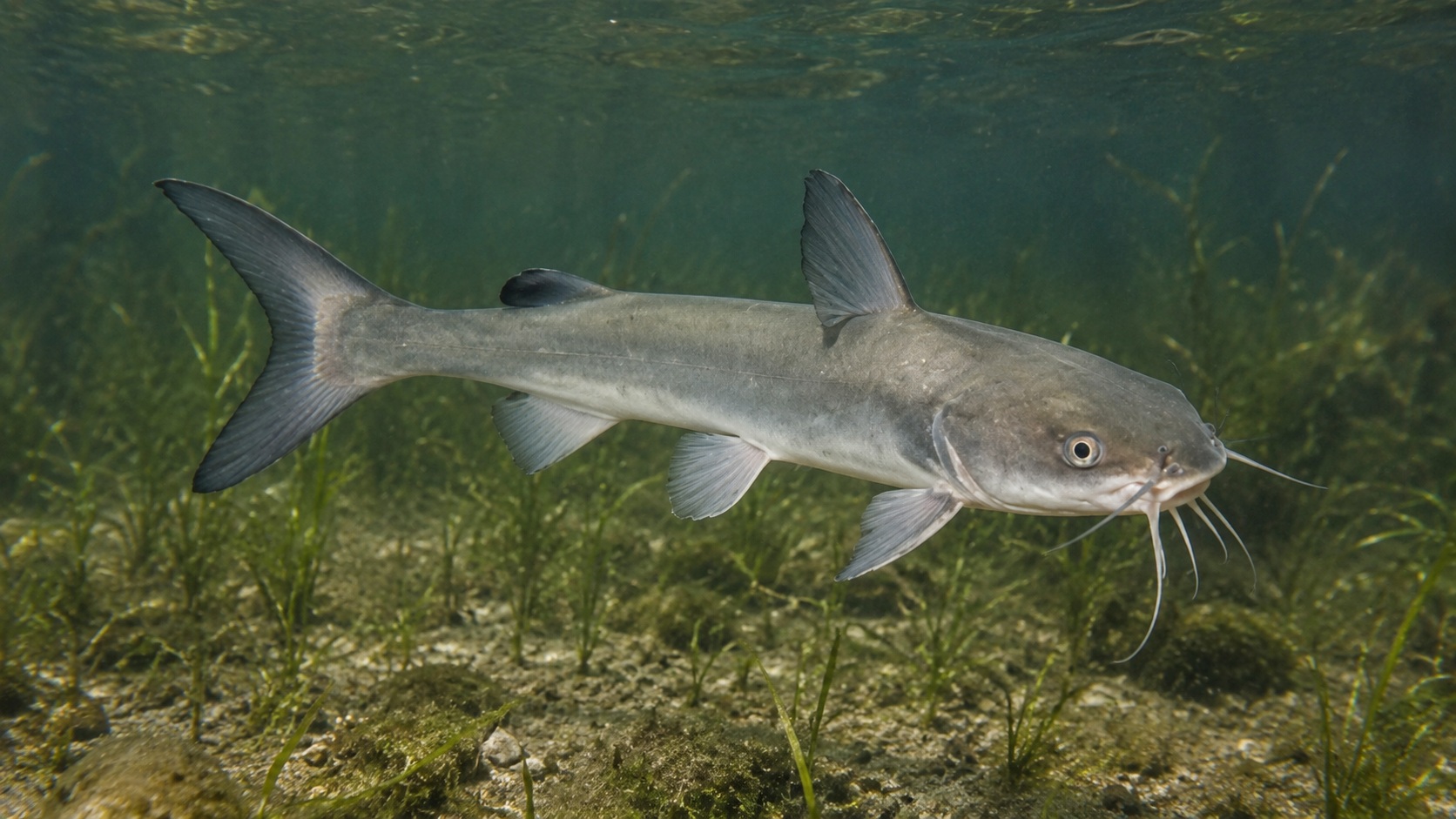
If you just pulled up a gray, whiskered fish with a flat bony head and three rigid spines sticking out of its fins, you caught a hardhead catfish. These fish are one of the most reliably caught species along the entire Gulf of Mexico coast and the lower Atlantic coast, from the bays of Texas and Louisiana east through the Panhandle and around to Virginia. If you fish inshore saltwater with bait anywhere in that range, you will catch them repeatedly. They are not a rare or exotic catch — they are the fish that shows up when you are fishing for redfish, flounder, or speckled trout and your bait hits the bottom. Most anglers from Corpus Christi to the Carolinas know them well. If you are new to saltwater fishing in this part of the country, the hardhead catfish is basically your welcome committee. The important thing to know right now: do not grab this fish bare-handed without reading the danger section first. Those spines are not decorative.
How to identify one
The hardhead catfish has a distinctive look that separates it from almost anything else you will pull out of a coastal bay or Gulf estuary.
The most immediately recognizable feature is the top of the head: there is a hard, bony plate running from between the eyes back toward the dorsal fin, with a raised ridge pattern on it. That bony plate is the origin of the common name “hardhead.” The fish is typically dirty gray or bluish-gray on the back and sides, fading to a white or pale yellow belly. They run small — most fish caught by recreational anglers are under 2 pounds, and even a large specimen rarely exceeds 3 to 4 pounds, though the species can technically reach 12 pounds.
Look for six barbels (whiskers): two at the corners of the mouth, and four underneath the chin. This barbel count is one of the clearest ways to distinguish the hardhead from its close relative and dockmate, the gafftopsail catfish (Bagre marinus).
Telling hardhead from gafftopsail catfish: These two species are caught in the same waters and are often confused. The gafftopsail is the showier fish — its dorsal fin has long, ribbon-like filaments extending from the tips, which look like the sail on a tall ship. The hardhead has no such filaments; its dorsal fin comes to a plain point and stays close to the body. Gafftopsails also have only four barbels compared to the hardhead’s six. If you see a saltwater catfish with dramatic extended fin streamers, it is a gafftopsail. If the fins are compact with no streamers and you count six whiskers, it is a hardhead.
People who have never seen either species sometimes think they have caught something unusual or even dangerous-looking. The hardhead is common enough that most experienced Gulf Coast anglers treat it as background noise, but it is a legitimate fish with some genuinely interesting biology behind it.
Is it dangerous?
Yes, and this is not a section to skip. The hardhead catfish has three venomous spines, and getting stabbed by one is a memorable and painful experience.
The spines: There is one spine at the leading edge of the dorsal fin (the fin on the back) and one at the leading edge of each pectoral fin (the two fins just behind the head on the sides). When the fish is agitated or handled, these spines lock rigidly upright and outward. They are sharp, slime-coated, and mildly venomous. The spines also have small rear-facing serrations that can make them difficult to pull cleanly from skin if you get stabbed.
What a sting feels like: A puncture from a hardhead spine causes immediate, intense throbbing pain at the wound site, followed by swelling and redness. The pain is disproportionate to the size of the fish — people describe it as burning and deep, lasting anywhere from 30 minutes to several hours depending on depth of the puncture. Infection is a real risk, particularly if the spine breaks off in the wound. If you cannot extract a spine fragment yourself, seek medical attention.
Teeth: Hardhead catfish do not have sharp teeth in the traditional sense. They have small, granular teeth arranged in patches that are used for crushing hard-shelled prey like crabs and shrimp. They will not bite through a finger, but do not put your fingers inside the mouth of a struggling fish.
No flesh toxins: The flesh of a hardhead catfish is not toxic. There is no tetrodotoxin, ciguatera, or other biological hazard in the meat itself.
The real danger summary: The spines are the hazard. A flopping, panicked fish can drive one of those spines into your hand or foot in a fraction of a second. Anglers lose their footing, try to grab a sliding fish off a wet deck, or reach into a live well carelessly — and get stabbed. Treat this fish with the same respect you would give a stingray. Use tools, not bare hands.
Where it comes from
Hardhead catfish are year-round residents of shallow coastal waters ranging from Virginia south around the Florida peninsula and along the entire Gulf Coast into Mexico and Central America. The core of their abundance runs from the bays and bayous of Louisiana and Mississippi, through Mobile Bay and the Alabama coast, across the Florida Panhandle, and west through the Texas coast from Galveston Bay down to the Laguna Madre. They are one of the most abundant inshore fish across this range.
They are highly tolerant of salinity changes and move freely between full saltwater, brackish estuaries, and river mouths. They prefer turbid, murky water over muddy or sandy bottoms, and they are bottom feeders. Their diet includes crustaceans (shrimp, crabs, fiddler crabs), worms, mollusks, and small fish — essentially whatever is available on or near the bottom. This opportunistic, bottom-hugging feeding style is exactly why they hit cut bait, shrimp, and mullet chunks intended for other species. They are not being targeted; they are just very efficient at finding food.
Hardhead catfish are most active and abundant when water temperatures climb into the 70s°F and above — generally spring through fall across most of their range, though in the warmest Gulf Coast estuaries (south Texas, south Louisiana) they remain active much of the year. They spawn in warmer water, typically late spring through summer, and during breeding season the males carry fertilized eggs in their mouths — a behavior called paternal mouthbrooding. A male incubating a clutch of eggs will not feed for up to 8 to 11 weeks while carrying the young until they are fully formed and released. This is one of the more remarkable reproductive strategies among fish found in North American coastal waters.
On the Table
The hardhead catfish is edible, but it is not held in high regard compared to most fish you are likely to pursue. Most experienced saltwater anglers release them immediately, and that is a reasonable choice.
The flesh is white and mild when the fish is fresh and from clean water. The main issue is that hardhead catfish inhabit murky, muddy estuaries and the meat can carry a muddy or “off” flavor, especially if the fish is not bled and iced immediately. Soaking fillets in milk or cold salted water for a few hours before cooking reduces this noticeably. They are best fried or in a fish stew, not baked or grilled, where subtle flavors matter more.
Cleaning a hardhead catfish is inconvenient. The tough skin requires skinning rather than scaling, and the three spines need to be clipped or carefully avoided during the cleaning process. Many anglers use heavy-duty shears to cut off the spines before filleting to prevent any chance of a post-death sting (the spines can still puncture even after the fish dies).
Regulations
Regulations for hardhead catfish vary by state. Most Gulf Coast and Atlantic states treat them as an unregulated or minimally regulated species with generous bag limits, but you should always verify current rules with your state’s fish and wildlife agency before keeping fish. Check your state agency’s website — Texas Parks and Wildlife, Louisiana Wildlife and Fisheries, Mississippi Department of Marine Resources, Alabama Marine Resources Division, the Florida Fish and Wildlife Conservation Commission, and the relevant agencies in Georgia, South Carolina, and North Carolina all publish current recreational rules online.
If you are going to keep one, keep only the freshest fish from the cleanest water you can find, clean it immediately, and cook it simply. It will be acceptable table fare. It is not a fish most people seek out twice.
What to do with it
Step one: Do not touch the spines. Before you do anything else, look at where the spines are pointing. The dorsal spine is on top, the two pectoral spines flare out to the sides near the head. A fish that is flopping on the deck or swinging on a line can rotate those spines toward your hand in any direction.
Getting the hook out: Use long-nose pliers or a dehooker. Do not use your fingers to free the hook if the fish is still active. Pin the fish against the deck or a cooler lid with a towel over the body (keeping the spines covered), then work the hook free with pliers. For deeply swallowed hooks, cut the line close to the hook and release the fish — the hook will dissolve or pass naturally. Do not dig for a swallowed hook, and do not put your hand in the fish’s mouth.
How to hold it: If you need to hold the fish for a photo or measurement, grip it firmly from the top with your palm flat against the fish’s back, fingers pointing toward the tail, and your thumb on one side of the body below the dorsal spine. This keeps the pectoral spines pointed away from your palm. Gripping around the head with a finger curled under the body is how people get stabbed by a pectoral spine. Keep your grip firm — a slipping fish is a dangerous fish.
If you get stabbed: Rinse the wound immediately with clean water. Soak the affected area in the hottest water you can tolerate without scalding — around 110 to 113 degrees Fahrenheit (43 to 45 degrees Celsius) — for 30 to 90 minutes. Heat helps denature the venom proteins and significantly reduces pain. Check that no spine fragment remains in the wound. Monitor for signs of infection over the next 24 to 48 hours (increasing redness, warmth, swelling, pus). If a spine fragment is embedded or infection develops, see a doctor.
Releasing the fish: Wet your hands or use a wet towel if you handle the fish, keep it in the water as much as possible, and lower it gently rather than dropping it. Hardhead catfish are extremely hardy and nearly impossible to kill through a typical catch-and-release interaction. They will be fine.
Should you keep it? That is your call. If you are fishing in an estuary with better options nearby — redfish, flounder, speckled trout, sheepshead — those are the fish most anglers prioritize. If you are curious and want to try cleaning one, keep a fresh fish from clean water, use tools not bare hands, and clip the spines before you start filleting.