A note about links: If we include links to retail sites like Amazon or Bass Pro Shops, it's because they're relevant to the topic and, as anglers ourselves, we believe they're worth checking out. As an Amazon Associate we earn from qualifying purchases.
Standing knee-deep on a black sand beach in Costa Rica, you spot a shape pushing a wake along the shoreline. Seven impossibly long dorsal spines knife above the surface, catching the morning light. That is a roosterfish, and your heart rate just doubled. These fish hunt the shallows like wolves, crashing bait schools with explosive violence, and they fight with a stubborn, headshaking power that bends heavy spinning rods into full arcs. No charter, no boat ramp, and no waiting for a weather window are required: you walk the beach, you spot the fish, and you make the cast.
How to identify one
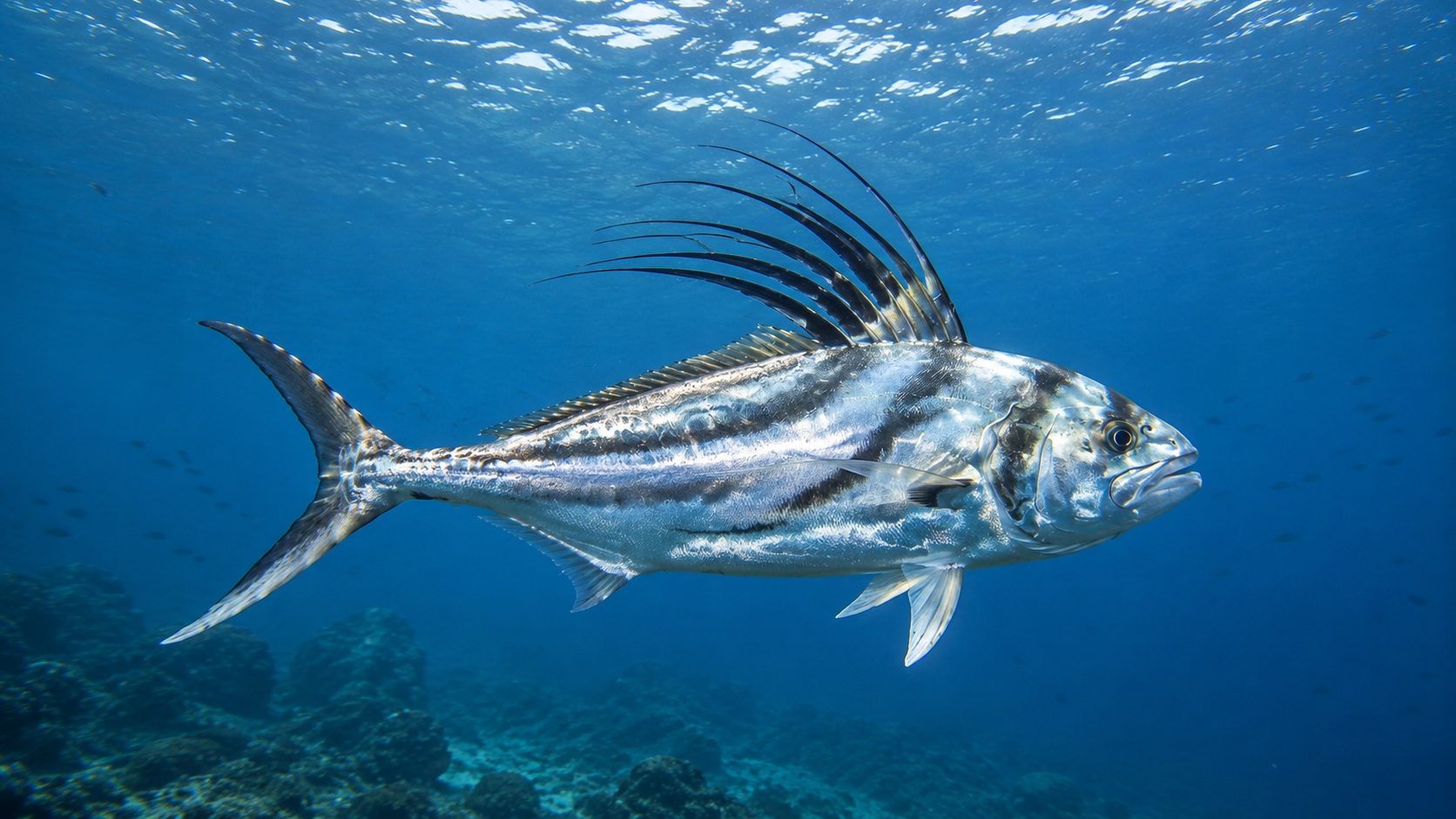
Nothing in the ocean looks like a roosterfish. The seven elongated spines of the first dorsal fin rise independently of the rest of the body, forming a crest that reaches nearly the height of the fish itself. The fish is compressed laterally and built like a torpedo, silver-gray with a faint iridescent sheen along the flanks. Two curved dark stripes arc from the dorsal region down toward the belly. Juveniles carry more pronounced vertical banding that softens with age. The mouth is large and toothy. At rest the comb lays flat; when the fish is excited, threatened, or feeding, those spines snap upright in a display that is instantly recognizable. No other Pacific inshore species comes close to matching it.
Where to find them
Roosterfish are a strictly eastern Pacific species. The range runs from Baja California south through Mexico, Guatemala, El Salvador, Honduras, Nicaragua, Costa Rica, Panama, Colombia, Ecuador, and Peru, reaching as far as the Galapagos Islands and Malpelo Island. They are not found in US waters.
The world’s top destinations cluster at three points. The East Cape of Baja California, centered on Los Barriles and the stretch of beach running north from Cabo Pulmo, offers classic run-and-gun sight fishing from pangas and ATVs along miles of open shoreline. The Central and South Pacific coasts of Costa Rica, including Quepos, Drake Bay, Matapalo Beach, and the Bat Islands near the Nicaraguan border, produce large fish year-round with catch-and-release charter operations that have built a global reputation. Panama’s Pacific coast, particularly the Coiba Archipelago, rounds out the bucket-list tier.
These fish live in shallow coastal waters rarely deeper than 20 meters. They patrol sandy beaches adjacent to reef structure, hunt the edges of rocky points, and push bait fish into the breaking surf. Juveniles concentrate in tidal zones and estuary mouths. Adults prefer the transition zone where sandy bottom meets hard structure.
When to go
Spring is the prime window across the entire range. In Baja, the bite from April through July is exceptional, with May and June representing peak conditions as water temperatures rise and bait schools concentrate near shore. In Costa Rica and Panama, roosterfish are present throughout the year due to consistently warm tropical water, but the dry season from December through April brings calmer seas, cleaner water, and high concentrations of fish along the Pacific shore.
Within any given day, early morning and late evening are the most productive windows. High tide pulls roosters tighter to the beach, placing them in range of shore casters and shallow-wading anglers. Midday heat in the tropics can slow the bite, though overcast conditions and active bait schools will keep fish feeding through the afternoon.
What to throw
Topwater poppers are the signature roosterfish bait, and the experience of watching a rooster engulf a surface lure is what keeps anglers booking return trips. Larger profiles in the 4 to 6 ounce range produce well. The Shimano Orca, Yo-Zuri Hydro Popper, and GT-style poppers in blue/white, green/yellow, and natural sardina patterns all work. The retrieve matters: a loud, aggressive chug-and-pause cadence draws strikes from fish that are shadowing the lure. Keep the popper moving during the retrieve because roosters frequently bump and circle before committing.
Stickbaits and sliders fished with a walk-the-dog presentation cover more water and work well when fish are not actively feeding on the surface. Fish them on heavy conventional or spinning tackle in the 40 to 80 pound braid range with a short fluorocarbon leader.
Live bait remains the highest-percentage method for large fish. A frisky mullet, sardina, or scad of 8 to 10 inches lip-hooked on a 1/0 to 2/0 circle hook, freelined into the surf or behind a slow-trolled panga, will draw strikes from fish that ignore artificials. In Baja, guides often tow a live bait as a teaser to raise roosters to the surface before switching to a fly or popper.
Fly tackle works superbly in the East Cape beach-fishing scenario. A 9-weight minimum is the starting point; many experienced anglers prefer a 10 or 11 weight when fish exceed 40 pounds. A clear intermediate sinking line handles most situations. Effective patterns include large baitfish streamers in olive/white or chartreuse/white, tied with a degree of bulk to push water, and large EP-style mullet imitations. Present the fly on the nose of a spotted fish and strip fast with long, steady pulls.
Regulations
Costa Rica: Roosterfish are catch-and-release only under INCOPESCA (Instituto Costarricense de Pesca y Acuicultura) regulations, codified in Board of Directors Agreement AJDIP 086-2014, Section 69. A valid Costa Rican sport fishing license issued through INCOPESCA is required. Circle hooks are mandatory when fishing with bait. FECOP (Federación Costarricense de Pesca) coordinates scientific tagging programs and works with INCOPESCA on enforcement and conservation.
Mexico (Baja California): Roosterfish may be retained subject to a daily bag limit of 2 fish, which count as 5 fish toward Mexico’s overall 10-fish daily limit. A valid Mexican sport fishing license from CONAPESCA is required. Regulations are enforced at the federal level and may change seasonally. Verify current rules with CONAPESCA or a licensed local outfitter before your trip.
Panama and other Central American countries: Regulations vary by nation and can include size limits, bag limits, and area-specific closures. Always consult the managing fisheries agency of the country you are fishing before departure.
Always verify current regulations with the managing authority before your trip, as rules change and local conditions may affect what is permitted.
Handling and release
Roosterfish do not eat well. The flesh is dark, strongly flavored, and not considered table fare by most anglers. Even in jurisdictions where retention is legal, most experienced anglers practice voluntary catch and release, and the growing body of post-release survival science supports this. A satellite-tagging study along the Central American coast found that properly released roosterfish survive at high rates when handling time is minimized.
Keep the fish in the water throughout the process whenever possible. Do not grip the comb dorsal, as the spines are sharp and the fish requires the fin for stability. Support the fish horizontally with wet hands under the belly, remove the hook quickly with pliers, take your photo in under 15 seconds, and release the fish head-first into the current. If the roosterfish is lethargic, hold it upright facing into any available current and move it gently forward and back until it kicks free under its own power. Circle hooks reduce deep hooking and speed up the release considerably, which is why Costa Rica mandates them when fishing with bait.
On the Table
Roosterfish is technically edible and eaten by locals in Mexico, Costa Rica, and Panama, but it is widely considered a poor-to-fair table fish — and the overwhelming consensus among sport anglers is to release it. Most guides throughout its range operate strictly catch-and-release, both out of conservation awareness and because the flesh simply does not reward keeping.
Taste and texture: The flesh is darker than most inshore species, closer in color and density to jack or small tuna, with a pronounced, sometimes gamey flavor. Younger, smaller fish are milder, but the taste can turn strong and pungent if the fish is not handled immediately. The texture is firm and dense rather than flaky, which works against mild preparations.
Best preparation methods: If you do keep one, these approaches make the most of its qualities:
- Grilling or searing: High heat caramelizes the surface and tames some of the stronger flavors. Marinating first in citrus and garlic for 30-60 minutes helps considerably.
- Ceviche: Acid from lime juice cuts the intensity and the firm texture holds up well without turning mushy. A popular local preparation along the Pacific coast of Central America.
- Tacos with bold toppings: Charred or pan-seared in pieces, the dense flesh works well under aggressive accompaniments like chipotle crema, pickled onion, or mango salsa that balance its stronger notes.
Sashimi or mild pan-frying are not recommended — those preparations highlight rather than mask the gamey notes.
Handling for table quality: Quality degrades fast. Bleed the fish immediately at the pier by cutting the gill arch, then get it on ice. When filleting, remove the bloodline completely — it runs deep and wide, and leaving any of it behind is the main reason people find roosterfish unpleasant. Cut a V-notch roughly 1/2 inch deep along both sides of the lateral bloodline and discard it entirely. Skin the fillets; the skin adds no value and contributes off-flavors. Use fresh fillets the same day.
Caveats: Roosterfish is strictly catch-and-release in Costa Rica by law, and most reputable sportfishing operations throughout Central America treat it as C&R regardless of local regulation. Check current rules for the country you are fishing before keeping any fish. No significant ciguatera risk is associated with roosterfish specifically, as it is not a coral-reef-dwelling species in the way barracuda or amberjack are, though it inhabits tropical and subtropical inshore waters where ciguatoxin-carrying baitfish are present. Mercury concerns are not elevated compared to other inshore species of similar size.