A note about links: If we include links to retail sites like Amazon or Bass Pro Shops, it's because they're relevant to the topic and, as anglers ourselves, we believe they're worth checking out. As an Amazon Associate we earn from qualifying purchases.
You are poling across a glassy flat in the Florida Keys, the water barely ankle-deep, when your guide murmurs “ten o’clock, sixty feet, three fish.” You see nothing at first. Then a tail breaks the surface, silver and sharp, tilting as the fish roots for a crab in the sand. You fire a cast, strip once, and the line comes tight. What happens next is a blur of screaming reel, backing you never thought you would see, and pure panic. Bonefish are pound for pound among the most explosive inshore fish in the world, and chasing them on the flats is one of saltwater fishing’s most demanding and addictive pursuits.
How to identify one
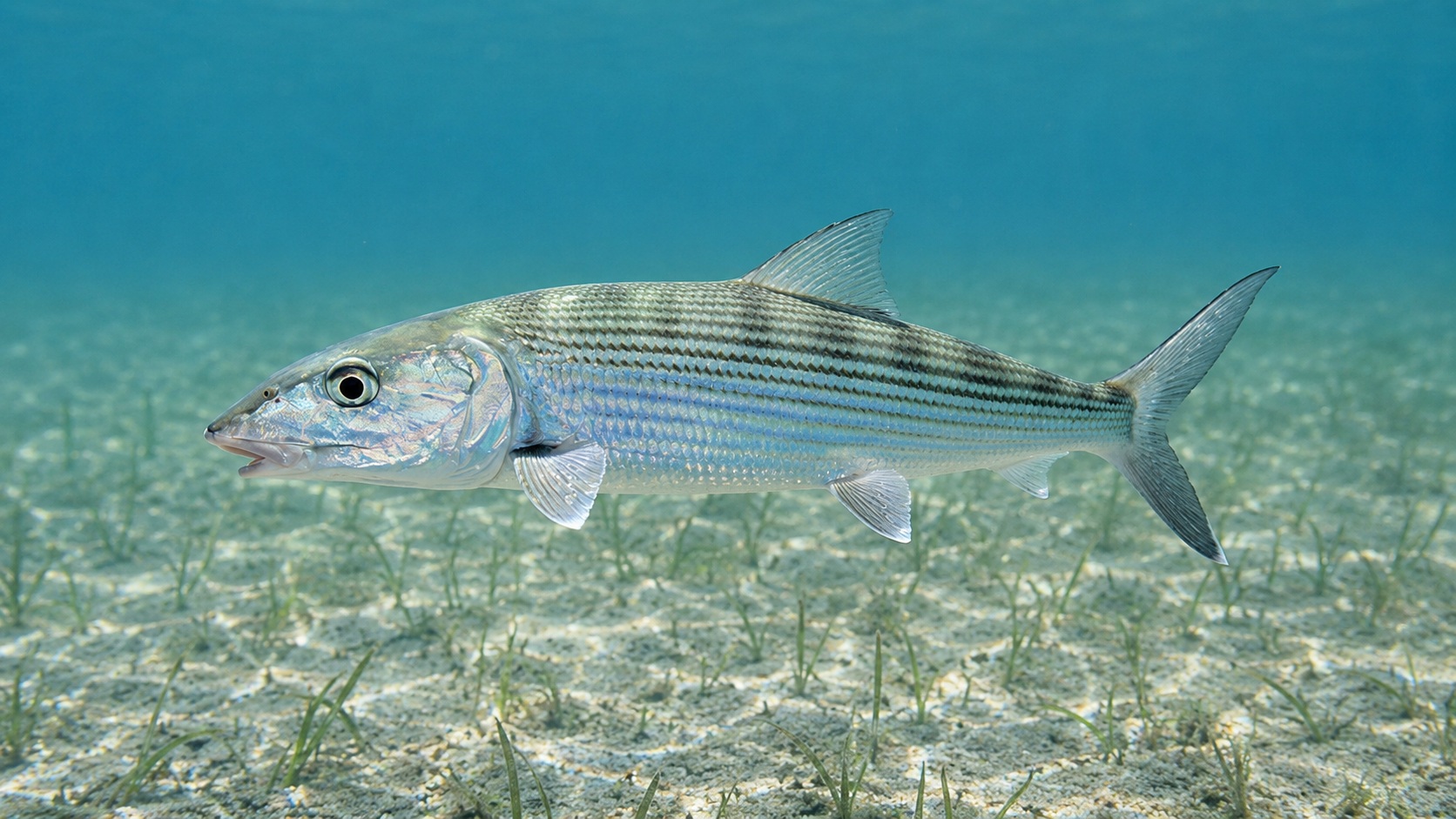
Bonefish are built for shallow water and speed. The body is long, deeply forked at the tail, and sheathed in large, mirror-bright silver scales with faint dark streaks running along the back. The snout is conical and overhangs the inferior mouth, a design purpose-built for rooting crabs and shrimp out of sand and grass. In the water, a bonefish is nearly invisible against the bottom, which is exactly the point. The telltale sign is the tail: when feeding in water less than 18 inches deep, bonefish tip nose-down and expose a forked, translucent tail above the surface. This is called tailing, and it is what flats guides scan for through polarized lenses all day long. Cruising fish show as dark, torpedo-shaped shadows moving with deliberate purpose. Nervous water, a subtle rippling disturbance on a calm surface, can betray a school moving in your direction before you ever see a body. The only close lookalike in Florida waters is the similar-looking ladyfish, which lacks the conical snout and is not found tailing on the flats.
Where to find them
Bonefish are creatures of the tropical flat, and nowhere in the continental United States are they more at home than in the Florida Keys and Biscayne Bay. The Keys offer classic terrain: shallow marl and sand flats, seagrass meadows, and mangrove edges from Key Largo down through Key West and into the Marquesas. Florida Bay and the backcountry flats north of Islamorada hold large populations. Biscayne Bay, just south of Miami, is one of the northernmost reliable bonefish grounds in the Atlantic and is accessible by skiff from Miami in under an hour. Beyond Florida, the Bahamas is the global center of bonefish culture: Andros Island, the Abacos, Eleuthera, Long Island, and the flats around Bimini all hold world-class populations. Bonefish forage on shallow flats during rising tides, pushing up onto the grass and sand to hunt, then retreating to deeper channels and basins as the tide drops. On the flats themselves, look for fish along the edges where deeper water meets the flat, around mangrove prop roots, and over clean sand patches where crabs and shrimp concentrate.
When to go
In the Florida Keys, bonefish are available year-round, but the peak window runs from March through October. Spring brings warming water and actively feeding fish in good numbers. Summer concentrates bonefish on the flats early in the morning and late in the afternoon, when the sun angle is low and polarized sight is easiest. Fall delivers some of the year’s largest fish as they bulk up before winter. Cold fronts in December through February push bonefish into deeper channels and make them difficult to find on the flats, though guides who know the backcountry can still locate fish in protected spots. Tidal timing matters as much as season. A rising tide pushing over a flat is prime time. Fish move with the water, and positioning yourself ahead of the tide line lets you intercept them as they come up to feed. Calm, sunny mornings with good light penetration and minimal wind make sighting and casting far easier.
What to throw
Bonefish in Florida and the Bahamas are almost exclusively targeted with fly fishing tackle. The standard outfit is an 8-weight rod paired with a large-arbor reel loaded with at least 150 yards of 20-pound backing and a weight-forward floating tropical fly line. Leaders run 9 to 10 feet tapered to a 10 to 16-pound fluorocarbon tippet. Heavier tippet is not a handicap; bonefish are not leader-shy in most conditions, and a stronger tippet shortens the fight and helps the fish survive release.
Shrimp patterns are the most versatile flies in the box. The Gotcha in pink or tan is the undisputed workhorse of Keys and Bahamas guides. The EP Ghost Shrimp in tan, tied with bead-chain eyes, lands softly and drifts naturally. Peterson’s Spawning Shrimp and the Borski Swimming Shrimp work well in calmer water where a slow sink is needed.
Crab patterns shine when fish are rooting on hard sand or around rocky bottom. The Merkin is the classic, but modern ties like the Alphlexo Crab and Strong Arm Merkin offer better durability and hook exposure. Heavier dumbbell eyes help the fly reach the bottom quickly in any current.
The cast should land two to four feet ahead of the fish and slightly to the side, not on top of it. Strip once or twice with short, sharp pulls to get the fly moving, then slow down and let it settle. Most takes happen as the fly falls. Watch for the fish to accelerate toward the fly or tip down; do not wait to feel weight before setting. Strip-strike firmly, keeping the rod low, and then hold on.
Light spinning tackle works as well, with small jigs of 1/8 to 1/4 ounce in shrimp colors and natural shrimp on a light hook being the most effective options for anglers not yet fly fishing. A 7-foot light spinning rod with 10-pound braid and a 15-pound fluorocarbon leader is a capable setup.
Regulations
In Florida, bonefish are a catch-and-release-only species. No harvest is permitted under any circumstances, and this has been the rule since September 1, 2013, when the Florida Fish and Wildlife Conservation Commission established a fully protected fishery. The use of multiple hooks in conjunction with live or dead natural bait is prohibited when targeting bonefish. Tournament exemption permits that previously allowed temporary possession for weigh-ins have been eliminated.
These protections exist because bonefish grow slowly, mature late, and are extremely sensitive to habitat loss and overfishing. Research by the Bonefish and Tarpon Trust has documented that bonefish support a significant recreational economy in South Florida and the Keys, with estimated angler expenditures running into the tens of millions of dollars annually. The fish is worth far more alive and releasing than it ever could be in a cooler.
Always verify current rules with the Florida Fish and Wildlife Conservation Commission before fishing. Regulations can change, and federal waters may carry additional requirements.
FWC Bonefish Regulations: https://myfwc.com/fishing/saltwater/recreational/bonefish/
Handling and release
Bonefish are fragile after a fight and require deliberate, fast handling to survive release. Keep the fish in the water as much as possible. Research from the Bonefish and Tarpon Trust shows that bonefish exposed to air for more than 15 seconds are six times more likely to die after release than fish kept wet throughout the entire process.
Wet your hands before touching the fish. Remove sunscreen and gloves first; chemicals that are harmless to human skin can damage the protective slime coat that shields the fish from infection. Support the fish horizontally with one hand under the belly and one near the tail. Never hold a bonefish vertically, as the weight of its organs can cause internal damage.
To revive an exhausted fish, hold it upright in the water and move it forward in slow arcs so that water passes over the gills from front to back. Moving the fish backward does not allow it to breathe. When the fish rights itself and the tail kicks with strength, open your hands and let it go. If sharks or barracuda are present, carry the fish to shallower water before releasing or wait until the predators move off. A bonefish that cannot escape is a bonefish that dies. The gray ghost deserves a clean exit.
On the Table
Bonefish are almost universally released, and for good reason — they are notoriously bony, subject to catch-and-release-only regulations in their most important U.S. fishery, and carry a modest ciguatera risk. Outside of a few Caribbean subsistence traditions, keeping a bonefish for the table is considered wasteful of a species whose economic value alive far exceeds its value as a meal.
Taste and texture: The flesh itself is not bad — white, firm, and mildly sweet with subtle hints of brine, comparable to other inshore flats species. The flavor is clean and relatively mild, without the strong “fishy” quality of oilier species. The problem is the bones: bonefish have an unusually dense network of small, needle-like intramuscular bones distributed throughout the fillet, making a clean table-ready cut genuinely difficult even for experienced filleters. Most anglers who have tried it conclude the effort is not worth the result.
Best preparation methods: In cultures where bonefish is eaten — primarily the Bahamas — the traditional approach sidesteps the filleting problem entirely. The fish is ground whole (bones included) and formed into fritters or fish cakes, then deep-fried; the grinding process pulverizes the smaller bones and the frying masks the texture of any that remain. If you are determined to eat one where legally permitted, grinding for fish cakes or fritters is the most practical method. Pan-frying thin scored pieces is a secondary option, as scoring severs many of the pin bones and the high heat produces a firmer crust that makes eating around remaining bones more manageable.
Handling for table quality: If keeping a bonefish is legal in your jurisdiction, bleed it immediately at the gills and place it on ice. Bonefish degrade quickly in warm flats water; any delay between catch and cooler accelerates the onset of off-flavors. Fillet as soon as possible and plan to use the fish the same day.
Legal status — Florida and U.S. waters: Bonefish have been catch-and-release only in Florida state waters since 2011. Possession is not permitted. Anglers fishing Florida Keys, Biscayne Bay, or any Florida flats must release all bonefish immediately. Check current state regulations before fishing any U.S. waters.
Ciguatera risk: Bonefish inhabit tropical reef and flat environments in the same geographic range where ciguatoxin accumulates. The risk is lower than for larger apex predators, but it is not zero. Larger, older fish carry higher toxin loads. This is an additional reason most guides recommend releasing all bonefish regardless of local legal status.