A note about links: If we include links to retail sites like Amazon or Bass Pro Shops, it's because they're relevant to the topic and, as anglers ourselves, we believe they're worth checking out. As an Amazon Associate we earn from qualifying purchases.
What just bit your line?
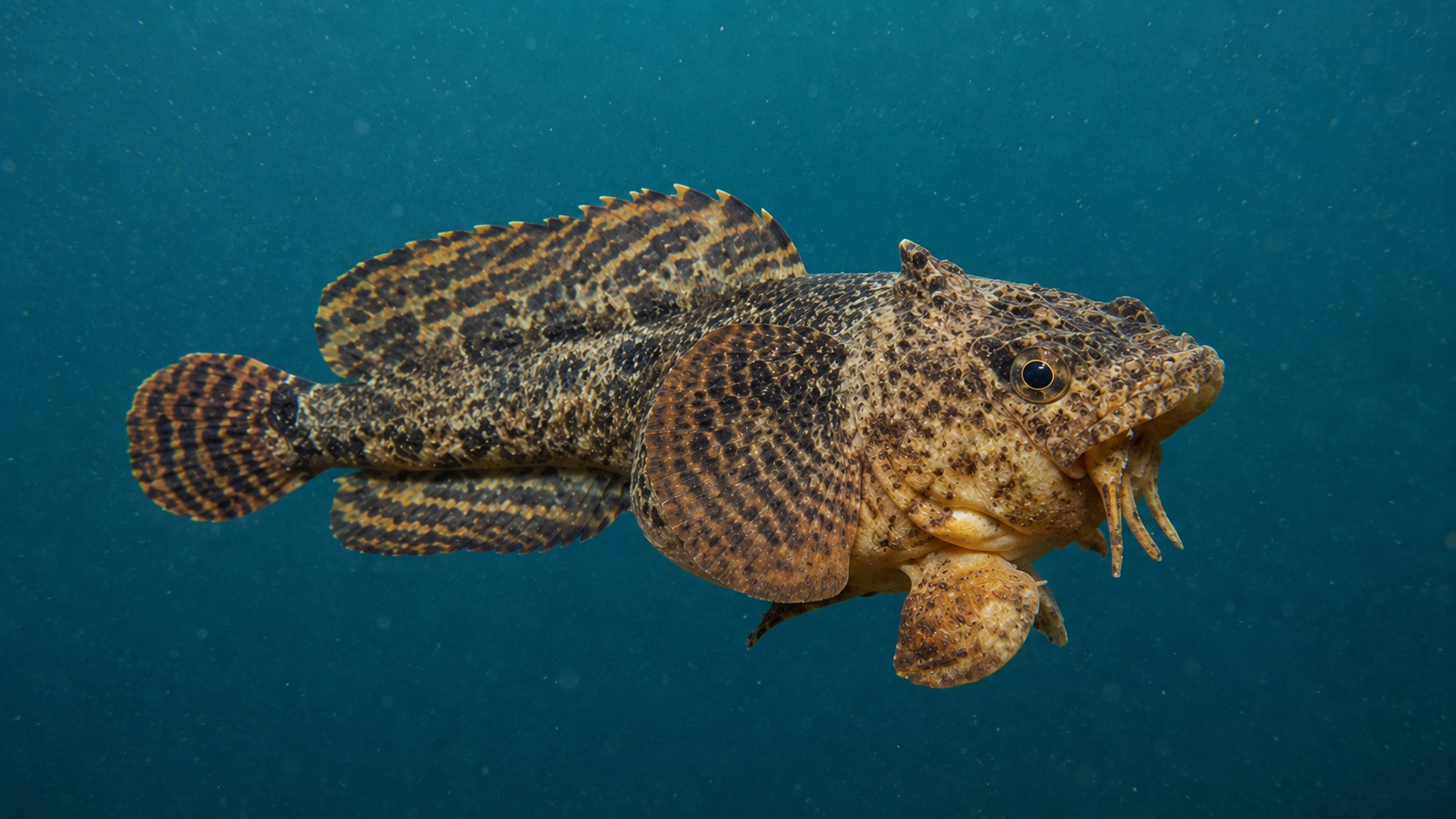
If you just pulled up a lumpy, wide-mouthed, scaleless bottom-dweller that looks like it lost a fight with a truck tire and seems genuinely angry about it, you caught an Oyster Toadfish. These fish are one of the most common surprises along the Atlantic coast from Maine to Florida, especially if you were fishing with cut bait or live shrimp near a dock, a riprap wall, or an oyster bar. They are immediately recognizable: a huge, flattened head with a wide frog-like mouth full of stubby crushing teeth, mottled brown and yellow skin with no scales, a fleshy fringe of skin flaps around the head, and eyes that sit high and almost seem to glare at you. They are, frankly, one of the ugliest fish you will find on a hook, and they know how to show it. Despite the alarming appearance and the bad attitude, this fish is not going to kill you. But you do need to know how to handle it safely before you grab it.
How to identify one
The Oyster Toadfish is hard to confuse with anything else once you have seen one, but if you have not, it can cause genuine confusion. Key field marks:
- Head and mouth: Massively oversized, broad, and flat. The mouth stretches nearly the full width of the head. Lips are thick and fleshy.
- Teeth: Short, blunt, and peg-like. These are designed for crushing crabs and shellfish, not slicing. They look intimidating but the teeth are rounded, not blade-sharp like a bluefish.
- Skin: No scales. The skin is slippery and covered in a heavy mucus coat. The color runs from olive-brown to yellowish-brown, patterned with darker oblique bars or blotches. The belly is typically pale or whitish.
- Fleshy flaps: There are distinctive skin flaps or “wattles” hanging from the chin and along the sides of the head. This is one of the most instantly recognizable features.
- Fins: Three sharp dorsal spines at the front of the dorsal fin, followed by a longer soft dorsal fin running most of the body length. The pectoral fins are large and paddle-like.
- Size: Most caught by anglers run 8 to 14 inches. The species can reach up to 17 inches, but fish over 15 inches are uncommon.
The only species that could cause confusion for an inexperienced angler is the closely related Gulf Toadfish (Opsanus beta), which looks nearly identical but is found in the Gulf of Mexico rather than the Atlantic coast. If you are fishing anywhere from coastal Maine south through Florida’s Atlantic side, what you have is almost certainly an Oyster Toadfish. No other common inshore Atlantic species shares the combination of the scaleless body, the enormous flat head, and the skin wattles.
Some anglers briefly mistake juvenile toadfish for some kind of exotic or tropical fish due to the unusual body shape. Others assume they caught a small goosefish or monkfish. The monkfish (Lophius americanus) is far larger and has a very different body shape; toadfish are compact and stubby where monkfish are elongated and tapered toward the tail.
Is it dangerous?
The Oyster Toadfish is not going to seriously harm you if you handle it sensibly, but there are two genuine hazards to be aware of.
Venomous dorsal spines: The three spines at the front of the dorsal fin and the spine on the operculum (gill cover) are venomous. These spines have venom glands at their base, and a puncture from one will deliver venom into the wound. The pain is typically described as similar to a bee or wasp sting - sharp, immediate, and localized. The venom is not systemic; it does not spread through your bloodstream and cause whole-body effects the way stonefish or stingray venom does. Most healthy adults experience localized pain and swelling that resolves within a few hours to a day. That said, the puncture still hurts, the wound carries a real infection risk, and the pain can be significant.
Treat a spine puncture with the standard hot water method used for venomous fish injuries: immerse the affected hand or finger in water as hot as you can comfortably tolerate (roughly 40-45 degrees Celsius, about 104-113 degrees Fahrenheit) for 30 to 90 minutes. Heat helps break down the protein-based venom and provides noticeable pain relief. Check the water temperature against an unaffected part of your body before submerging the wound to avoid scalding. Watch the wound for signs of infection in the following days - redness spreading from the puncture site, swelling, warmth, or discharge are reasons to see a doctor. Tetanus protection is worth keeping current if you fish regularly.
Teeth and jaw strength: The toadfish’s teeth are blunt, but the jaw is strong. These fish routinely crush crab shells and oysters. A toadfish that clamps down on a finger will not slice it off, but it can apply enough pressure to cause pain and bruising, and can break skin. Do not put fingers near the mouth.
The flesh is not toxic. Unlike pufferfish, toadfish flesh contains no tetrodotoxin or other toxins. The meat is completely safe to eat once the fish is properly cleaned. The venom stays in the spines; it does not affect the edibility of the meat.
Where to find them
The Oyster Toadfish ranges along the entire Atlantic coast of the United States, from Maine south through Florida and into the Caribbean. It is a year-round resident of estuaries, tidal creeks, and shallow inshore waters, though it is most active and most frequently caught during spring and summer when water temperatures warm and the fish are in spawning mode.
In the Northeast and mid-Atlantic, this is an extremely common species. Anglers fishing the bays and harbors of Long Island, the tidal rivers and coves of Connecticut and Rhode Island, Cape Cod and the Massachusetts South Shore, Narragansett Bay, and the lower Delaware Bay turn up toadfish regularly on bottom rigs. In the Chesapeake Bay — one of the densest toadfish habitats on the coast — they are practically unavoidable when fishing oyster reefs, dock pilings, and riprap shorelines. The same is true along the tidal creek systems of New Jersey, Maryland, and Virginia. In many of these areas, toadfish are present from roughly spring through late fall, retreating to deeper water as temperatures drop in winter.
In the Southeast, toadfish inhabit the tidal marsh creeks, dock structures, and oyster bars of the Carolinas, Georgia, and Florida’s Atlantic coast. The species is common in any back-bay estuarine system with structure — it does not require clear water or pristine habitat.
This species is built for structure. It spends its life on the bottom, wedged under rocks, nestled into oyster reef crevices, hiding inside old crab traps, tucked under dock pilings, or simply sitting motionless in the mud or sand waiting for something edible to wander by. It is a textbook ambush predator. The mottled coloration is near-perfect camouflage against a shell-and-mud bottom.
The Oyster Toadfish is one of the most salinity- and temperature-tolerant fish in its range. It handles the wide swings in water quality typical of back-bay estuaries far better than more sensitive species, which is part of why it thrives in the kinds of turbid, low-oxygen harbors and tidal flats where many other fish are scarce. It can tolerate water conditions that would stress a flounder or a weakfish.
Diet is centered on hard-shelled prey: crabs, mollusks, shrimp, and small fish. The crushing dentition is specifically adapted for cracking shells. This is why it hits cut crab, cut shrimp, and cut clam so readily - that is exactly what it evolved to eat. It will also take small fish-imitating soft plastics and occasionally a piece of cut mullet or menhaden fished on the bottom.
Male toadfish are well known for their acoustic courtship calls. During the spring and summer spawning season, males produce a distinctive foghorn-like “boatwhistle” call using their swim bladder to attract females to nest sites under rocks and shells. If you have ever heard a mysterious low-pitched honking or humming coming from under a dock at night in the summer along the Atlantic coast, there is a reasonable chance it was a toadfish.
When to go
Toadfish are present in most of their range year-round, but they are most catchable when water temperatures climb above roughly 60°F (15°C). Feeding activity and movement increase significantly as water warms into the 65-75°F range during spring and summer. This is also when males are actively defending nest sites and calling, which makes them more aggressive and more likely to strike bait.
Timing shifts considerably by latitude. In the mid-Atlantic and Chesapeake Bay region, expect peak activity from late April or May through September. In southern New England, peak season typically runs from May or June through late summer. In the Southeast, toadfish are active earlier in spring and may remain catchable well into fall. During the coldest months in the northern part of the range, toadfish move to deeper water and are rarely encountered inshore.
Bottom fishing with cut crab, clam, or shrimp near structure will produce toadfish through most of the active season. They bite most readily at night and during low-light periods, though they will hit bait during daylight as well.
Regulations
Oyster Toadfish are not managed as a targeted commercial or recreational species at the federal level. Regulations vary by state, and many states have no specific size or bag limits for toadfish. That said, rules can differ along the coast, so check your state fish and wildlife agency’s current regulations before keeping any fish. When in doubt about water quality in your area — particularly in harbors, near marinas, or adjacent to industrial shorelines — check your state’s fish consumption advisories. Like any bottom-feeding species, toadfish can accumulate contaminants from polluted sediment.
On the Table
Here is the part that surprises most anglers: the Oyster Toadfish is legitimately good to eat. It is not a trash fish in terms of table quality. The flesh is firm, white, and mild with a clean, slightly sweet flavor. The texture has been compared to a dense whitefish - not flaky in the way a flounder is, but moist and meaty. One pound of toadfish yields roughly 6 to 10 ounces of usable meat.
The challenges are entirely about preparation, not about the quality of the fish itself. The skin is tough, slimy, and should be removed before cooking. The body structure is bony in a way that requires attention during cleaning. Here is a method that works well:
- Kill the fish humanely and quickly by spiking the brain through the top of the head with a knife or spike.
- Using heavy scissors or shears, cut away all of the fins - including the venomous dorsal spines, which you should remove first and discard carefully.
- Score around the skin at the head, then grip the skin with pliers or a dry rag and pull it off toward the tail in one motion, the same way you skin a catfish.
- Gut the fish, then rinse the carcass well.
- The meat comes primarily from the body behind the head. Some anglers briefly steam the carcass to loosen the flesh from the bones before picking it.
- Cook the meat by frying, grilling, or incorporating it into tacos or chowder. It holds up well to high heat without falling apart.
A 12-inch or larger toadfish will give you a meaningful amount of meat. Smaller fish are better released.
The reputation for being inedible comes almost entirely from their appearance. Anglers who have never tried one assume the ugly fish must be unpleasant to eat. The ones who do try it are usually surprised.
What to do with it
Getting the hook out: Use long-nose pliers or a dehooker. Do not reach into the fish’s mouth with bare fingers - the teeth are blunt but the jaw is strong and you do not need the bruise. For a deeply swallowed hook, cut the line close to the hook and release the fish; a toadfish’s gut is tough and it will likely work the hook out or it will corrode.
How to hold it: The safest grip is a firm two-handed hold from behind the pectoral fins, with your thumb and forefinger wrapped around the body just behind the gill plate - keeping your hand away from both the dorsal spines (pointed forward and up) and the mouth. Do not squeeze the gill plate area; the opercular spine is there. A folded wet rag or a fish grip tool makes this easier. Gloves are a reasonable precaution.
If you got stabbed by a spine: Soak the puncture in water as hot as you can tolerate (not scalding - test it with an unaffected area first) for 30 to 90 minutes. The heat denatures the venom protein and significantly reduces pain. Clean the wound with soap and water, apply an antiseptic, and monitor for infection over the next 48 hours. If redness or swelling spreads, or if you have any allergic reaction (difficulty breathing, widespread hives, dizziness), seek medical attention.
Releasing it: Toadfish are hardy. A healthy fish can be lowered back to the surface of the water and released without issue. They do not need to be revived like a weakfish or a trout; just let it go at the waterline and it will swim down on its own.
Worth keeping? If you are fishing somewhere with clean water and you have a fish over about 12 inches, it is worth considering as table fare if you are willing to put in the cleaning work. If you are fishing in a known polluted harbor or near a storm drain outfall, release it - like any bottom feeder in contaminated water, the flesh can accumulate whatever is in the sediment. When in doubt about water quality in your area, check your state’s fish consumption advisories.