A note about links: If we include links to retail sites like Amazon or Bass Pro Shops, it's because they're relevant to the topic and, as anglers ourselves, we believe they're worth checking out. As an Amazon Associate we earn from qualifying purchases.
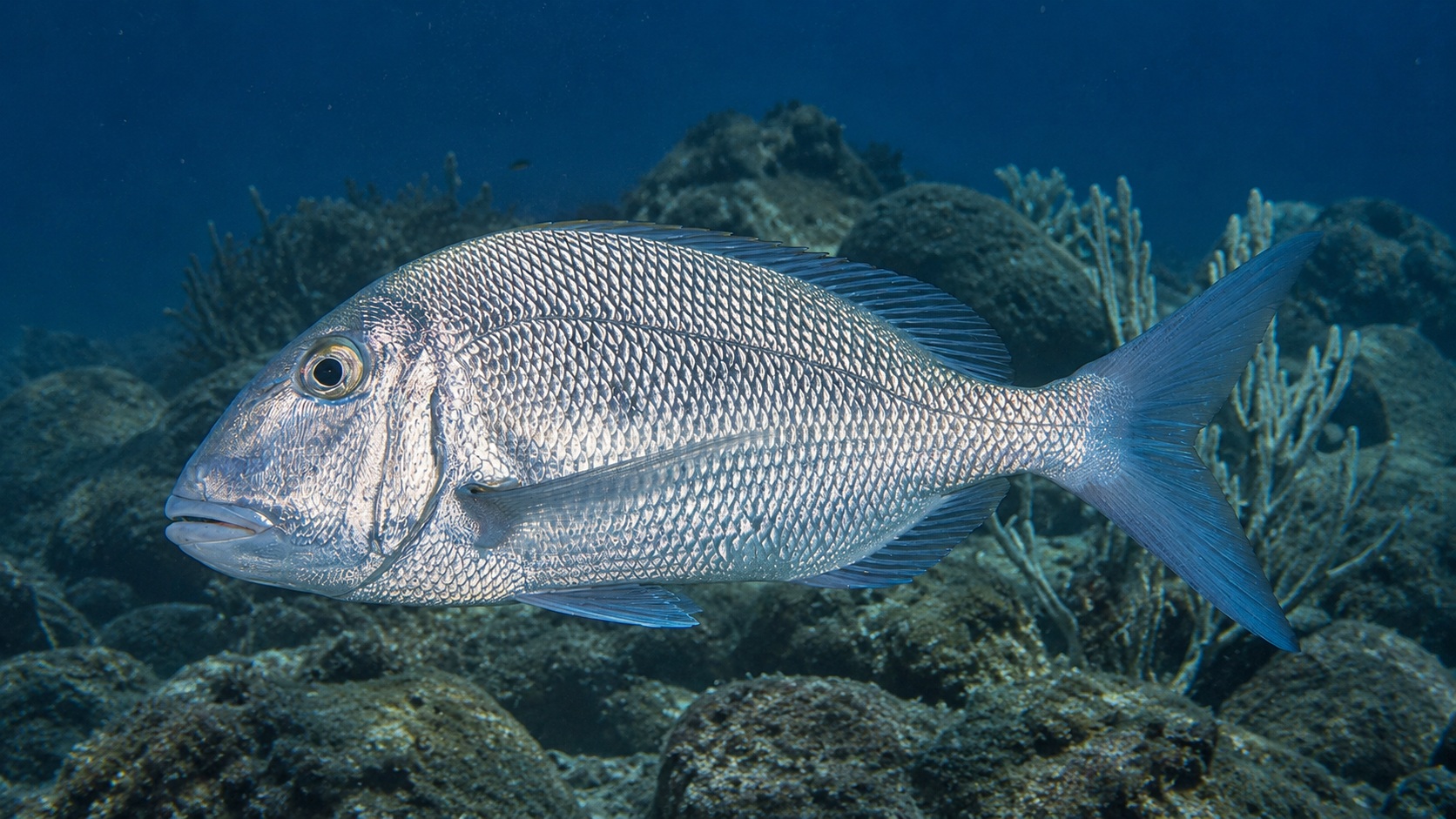
Spend a day bottom fishing the patch reefs and hard bottom of the Florida Keys and sooner or later a porgy comes over the rail — a tall, silvery, blue-and-bronze fish with a big eye and a hard, blunt face. In the Keys “porgy” usually means the jolthead porgy, the largest and most common of several Calamus porgies on the reef. They are not glamorous, they are not what you ran offshore for, and most anglers grin anyway — because a porgy fights well above its weight on light tackle and turns into some of the sweetest fillets you will eat all season. They are the reef’s underrated dinner fish.
How to identify one
The jolthead porgy is a deep-bodied, big-eyed member of the sea bream family (Sparidae). It is silvery overall with a brassy or bluish sheen, blue lines and spots around the head and along the snout, and a distinctive blue stripe under the eye. The mouth is small but the jaws are powerful, packed with strong molar-like teeth for crushing crabs, urchins, and shellfish. The “jolthead” name is old Keys folklore; what you will notice is the steep, blunt forehead on bigger fish.
Most reef porgies run 12 to 18 inches and a pound or three. A fish over 4 pounds is a good one, and they reach 8 pounds and roughly two feet. Several close cousins share the reef and the “porgy” name — the saucereye porgy (big golden eye, blue lines), the sheepshead porgy, and the littlehead and knobbed porgies — and all are caught and eaten the same way. If it is a tall, silvery, big-eyed bottom fish with crushing teeth and blue facial markings, you have a porgy.
Where to find them
Porgies range the western Atlantic from the Carolinas through the Caribbean, but South Florida, the Keys, and the Bahamas are the heart of the fishery. They are hard-bottom and reef dwellers.
Look for them over:
- Patch reefs and the reef line in Hawk Channel and along the Keys, typically in 15 to 90 feet. Porgies love structure with relief and live bottom around it.
- Hard bottom, rubble, and rocky ledges — often the same spots you anchor on for yellowtail, mangrove, and mutton snapper. Porgies are a constant, welcome presence there.
- Deeper hard bottom and ledges out to a few hundred feet, where the biggest joltheads live.
- Grass flats and channel edges for juveniles and smaller fish, especially in the backcountry and around the islands.
They are not loners — where you catch one porgy you will usually catch several. If the snapper bite goes quiet, dropping a bait to the bottom on the same reef will usually find porgies.
When to go
Porgies are available year-round in the Keys and South Florida, which is a big part of their appeal — they are a dependable bottom fish in every season.
- Spring and summer: Prime. Warm water, active fish, and steady reef and hard-bottom bites. Often caught alongside the spring and summer snapper fishing.
- Fall: Still excellent on the reef and hard bottom.
- Winter: Reliable when weather lets you fish — porgies keep biting the bottom when other species slow down, making them a great cool-season target.
As with most reef fishing, moving water makes the difference. A running tide or current that pushes scent across the bottom turns the bite on; dead-slack water slows it down. A little chum over the side keeps porgies (and snapper) stacked under the boat.
What to throw
Porgies feed on crabs, shrimp, mollusks, and urchins crushed with those molar teeth, and they take a bottom bait readily. This is simple, productive bait fishing.
Bait:
- Cut bait (ballyhoo, squid, or fresh cut fish), live or fresh dead shrimp, and small crabs are all excellent. Shrimp and squid are the everyday porgy baits.
- Fish small, fresh chunks. Porgies have small mouths and pick at a bait, so a bite-sized piece on a sharp hook out-produces a big bait.
Rigs:
- A knocker rig (egg sinker sliding down to the hook) or a simple fish-finder/chicken rig on the bottom is ideal around reef and hard bottom. The knocker rig keeps you in contact with structure and helps pull fish up out of the rocks.
- A small jig tipped with shrimp, or a bucktail bounced on the bottom, also takes porgies.
- Use a fluorocarbon leader (20 to 40 lb) and a 1/0 to 3/0 hook sized to the bait.
Tackle and technique: Light to medium spinning or conventional gear with 15 to 30 lb line is plenty and makes the fight fun. Get the bait to the bottom, stay in contact, and set on the steady pull — porgies nibble, so do not wait too long. Be ready to lift them away from the rocks quickly; like snapper, a hooked porgy heads for cover.
Regulations
Porgies in the South Atlantic (including Florida) are managed as part of the federal snapper-grouper complex, and the rules can change. Recreational size and bag limits, and how state and federal waters differ, are set by the FWC and the South Atlantic Fishery Management Council. Always confirm the current rules before you keep fish.
General notes:
- Porgies have at times carried a combined recreational bag limit within the snapper-grouper complex — check the current per-person limit before keeping a mess of fish.
- Size limits and seasons can differ between Florida state waters and federal waters offshore.
- A valid Florida saltwater fishing license (or a charter that covers you) is required.
Because the specifics shift, verify the current porgy rules with FWC before your trip.
Handling and release
Porgies are tough, but their spiny dorsal fin and gill covers are sharp — handle them with a grip across the back or a towel.
- Most reef porgies come from moderate depth and release well. Fish pulled from deeper water (roughly 50-plus feet) may show barotrauma — a distended belly or bulging eyes. Use a descending device to return those fish to depth rather than venting if you are unsure; it dramatically improves survival.
- Wet your hands, support the fish horizontally, and minimize air time for any you release.
- Keep only what you will eat and release the rest to keep the reef productive.
On the Table
Porgy is one of the best-kept secrets of Keys bottom fishing — the meat is white, sweet, firm, and clean, and many guides rate a fat jolthead above the snapper that share its reef.
Taste and texture: Sweet and mild with firm, white, medium-flaked flesh and no strong fishy note. Comparable to snapper or hogfish in quality.
Best preparation methods:
- Pan-fried or fried: The Keys standard — fillets or whole scaled fish dredged and fried until the skin crisps.
- Grilled or whole-roasted: A scaled, scored porgy is excellent on the grill or roasted with citrus and herbs.
- Fillets: Larger porgies fillet into clean, boneless sides for sautéing, broiling, or fish tacos and ceviche.
Handling for table quality: Bleed and ice fish immediately in the Keys heat — it makes a big difference. Smaller porgies are a touch bony and are great cooked whole; bigger fish fillet cleanly. Scale before cooking if leaving the skin on.
Eating caveats: Porgies are a clean, well-regarded food fish. Ciguatera risk is low for porgies compared with large predatory reef fish, but in the Keys and Caribbean it is never zero on the reef — follow local guidance, and as always, eat smaller fish and avoid the largest specimens from known ciguatera areas.