A note about links: If we include links to retail sites like Amazon or Bass Pro Shops, it's because they're relevant to the topic and, as anglers ourselves, we believe they're worth checking out. As an Amazon Associate we earn from qualifying purchases.
Most gar species prefer clear or moderately turbid water with aquatic vegetation and some visibility. Shortnose gar did not get that memo. They are the most turbidity-tolerant gar in North America, comfortable in the brown, silty, opaque water of the Mississippi and Missouri River mainstreams and the murky backwater lakes and sloughs that border them. While longnose and spotted gar are fishing the cleaner tributaries and reservoirs, shortnose gar are holding in the slow bends of the big river, in the flooded timber of the backwaters, and in places where you cannot see your hand six inches below the surface.
They are also the smallest common gar. An 18- to 24-inch shortnose gar is a typical catch; a fish over 30 inches is large. Most people who catch them are fishing catfish on the Missouri River main channel, or crappie in a Mississippi River backwater lake, and something small and heavily armored shows up that they do not immediately recognize.
What You Are Looking At
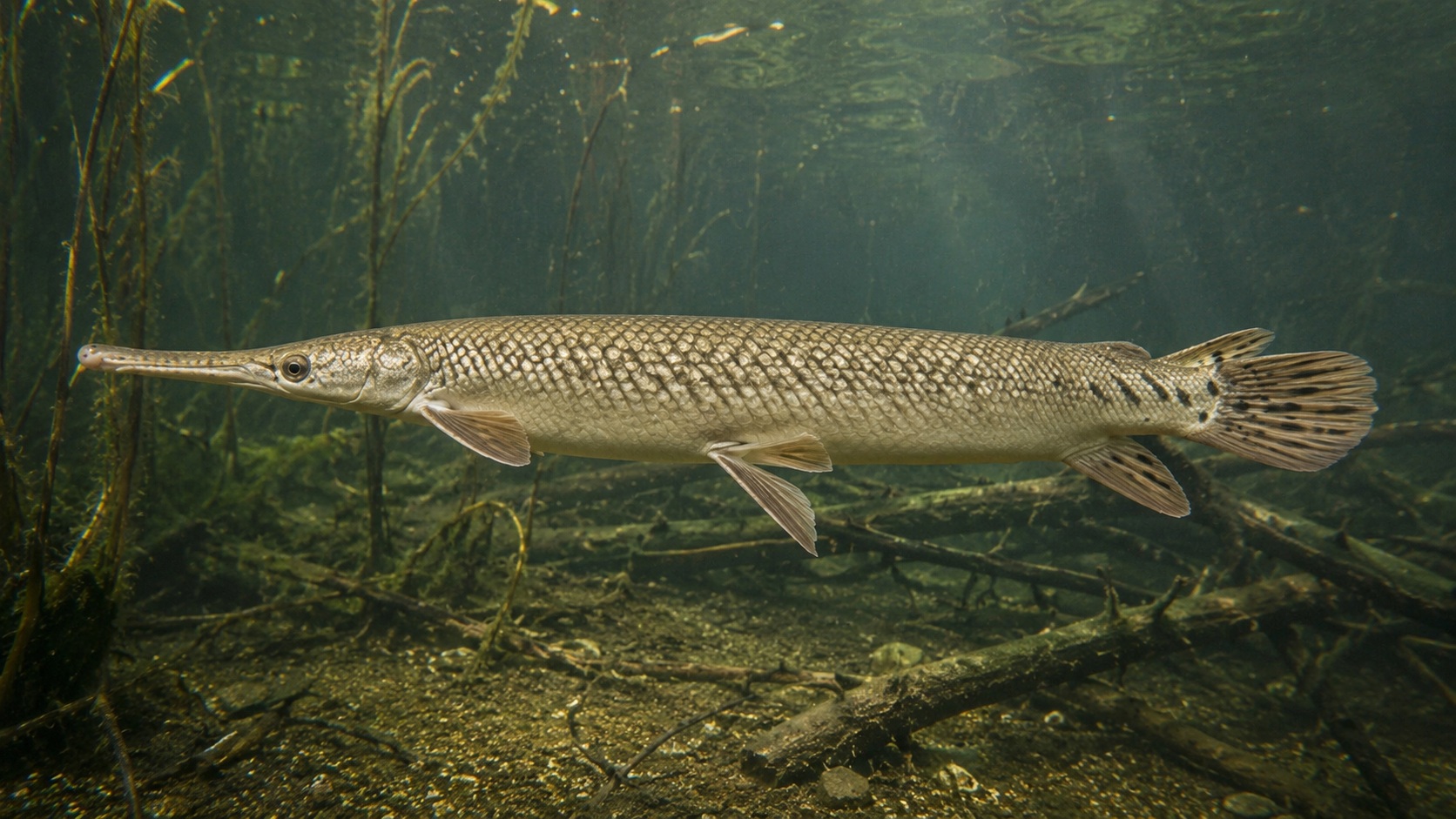
Shortnose gar are identified primarily by the snout, which is notably short, broad, and somewhat flattened at the tip — the “duck-billed” common name captures it accurately. Of all the North American gar species, the shortnose has the most abbreviated, wide snout relative to its head size. It is clearly a gar, but the snout is so much shorter than what you might picture from a longnose or even a spotted gar that the fish can look almost blunt-headed by comparison.
The body is the standard gar cylinder: long, round in cross-section, covered in hard ganoid scales that feel like fingernail material and interlock tightly across the entire body. The coloration is typically olive to brownish-gray, often with a somewhat uniform, unspotted appearance — or very faint, indistinct spotting that is nowhere near as bold as on spotted or Florida gar. The belly is pale to white.
In turbid water, identification is mostly by snout shape and size. A small gar with a noticeably short, wide snout in the Mississippi or Missouri River drainage is almost certainly a shortnose. A fish of the same size with a longer, needle-like snout in similar habitat is probably a longnose, which can also be found in these systems.
Like all gar, shortnose gar breathe air. In the low-oxygen backwater lakes and sluggish side channels where they often live, this is a significant advantage. Surfacing to gulp air is a normal behavior, not a sign of distress.
Where They Live
The shortnose gar’s core range is the Mississippi River and its major tributaries: the Missouri River system from Montana and the Dakotas downstream; the upper and lower Mississippi through Illinois, Missouri, Iowa, Minnesota, Arkansas, and Louisiana; the Ohio River and its lower tributaries in Indiana, Kentucky, and Ohio; and eventually the Gulf Coast reaches of the lower Mississippi drainage. They are also found in some lower Great Lakes tributaries.
This species is the gar of the big, turbid river interior. Backwater lakes — the oxbow lakes and sloughs that form along major rivers when old channels are cut off — are some of the best shortnose gar habitat anywhere. These waterbodies are warm, shallow, often choked with submerged timber from periodic flooding, and low in dissolved oxygen from decomposing organic material. Most species that require good water quality cannot persist there. Shortnose gar are at home.
In the river main channel, they favor the slower edges, backwater pockets behind islands, and the flat, slow inside bends rather than the fast outside curves. They do not hold in fast current. In reservoirs and lakes connected to the river system, they orient to warm, shallow, vegetated or timbered areas rather than the open water mid-lake habitat.
How to Handle One Safely
Shortnose gar carry the same safety considerations as all gar: rows of small, sharp, inward-pointing teeth in both jaws, rough ganoid scales that will abrade skin, and an energetic thrashing response when lifted from the water.
For a small shortnose gar (under 24 inches), the practical handling approach is straightforward: use pliers or a de-hooking tool to free the hook, grip the fish around the body behind the gill plate, and keep fingers away from the jaw. The teeth are not large on this species, but they are sharp enough to cut.
If the fish took the bait deeply, long-nose pliers and patience, or cutting the leader close to the hook, are both practical solutions. Gar hooks tend to rust out of soft tissue reasonably quickly.
Release is easy: lower the fish to the water, let it orient, and release. Shortnose gar are tough and recover quickly from catch-and-release in any conditions they are likely to encounter.
Roe is toxic. The eggs of all gar species, including shortnose gar, contain ichthyotoxin, a protein-based toxin that causes gastrointestinal illness in humans and is dangerous or fatal to dogs, cats, and other mammals. Do not eat gar eggs. Do not let pets eat discarded roe or entrails from a female gar. The muscle flesh is safe; the eggs are not. This applies to every gar species, regardless of size.
Can You Eat It?
Shortnose gar are edible but are rarely worth keeping for the table given their small size. Even a good-sized fish in the 20- to 24-inch range yields limited meat after accounting for the head, scales, and the numerous fine bones distributed through the flesh. Anglers who do eat them typically score the sides and fry the fish in sections, picking through the meat at the table.
For those committed to eating shortnose gar, the meat is similar to other gar species: white, mild, and palatable. The bones are the primary obstacle. Ground or processed gar meat (similar to gar patties or fish cakes) is the most practical preparation for a small fish where clean filleting is nearly impossible.
Most anglers who encounter shortnose gar incidentally release them without a second thought. They are small, bony, and not the reason you were on the water — but they are interesting, and worth a look before they go back.
The Case for Knowing Your Gar
Shortnose gar do not get much attention. They live in water that is not glamorous: turbid river backwaters, flooded timber zones, slow side channels that smell like mud and decomposing leaves. They are small compared to their famous relatives. They do not leap dramatically or run for deep water.
What they do is occupy habitat that almost nothing else occupies as effectively, in a river system that most people have heard of but not fished. The Missouri River, the upper Mississippi, the oxbow lakes along the lower river in Arkansas and Louisiana — these are wild, productive, overlooked fisheries. Shortnose gar are part of what makes them work, keeping populations of small fish in check in the low-oxygen backwaters that other predators cannot consistently use.
When you catch one, you are holding a fish specifically adapted to thrive where the river is at its most hostile and opaque. That is worth something.