A note about links: If we include links to retail sites like Amazon or Bass Pro Shops, it's because they're relevant to the topic and, as anglers ourselves, we believe they're worth checking out. As an Amazon Associate we earn from qualifying purchases.
If kelp bass own the open coast, spotted bay bass own the back bays. The “spottie” is the fish that turns a quiet morning in San Diego Bay, Mission Bay, or Newport’s Back Bay into a fast, light-tackle workout. It is the species that hooks new Southern California anglers for life: aggressive, abundant, structure-loving, and perfectly willing to crush a soft plastic dragged across an eelgrass flat from a kayak, a skiff, or the end of a dock. They do not grow huge, but pound for pound they pull hard, bury into structure the second they feel the hook, and live in calm, accessible water you can fish year-round without a boat big enough for the ocean.
How to identify one
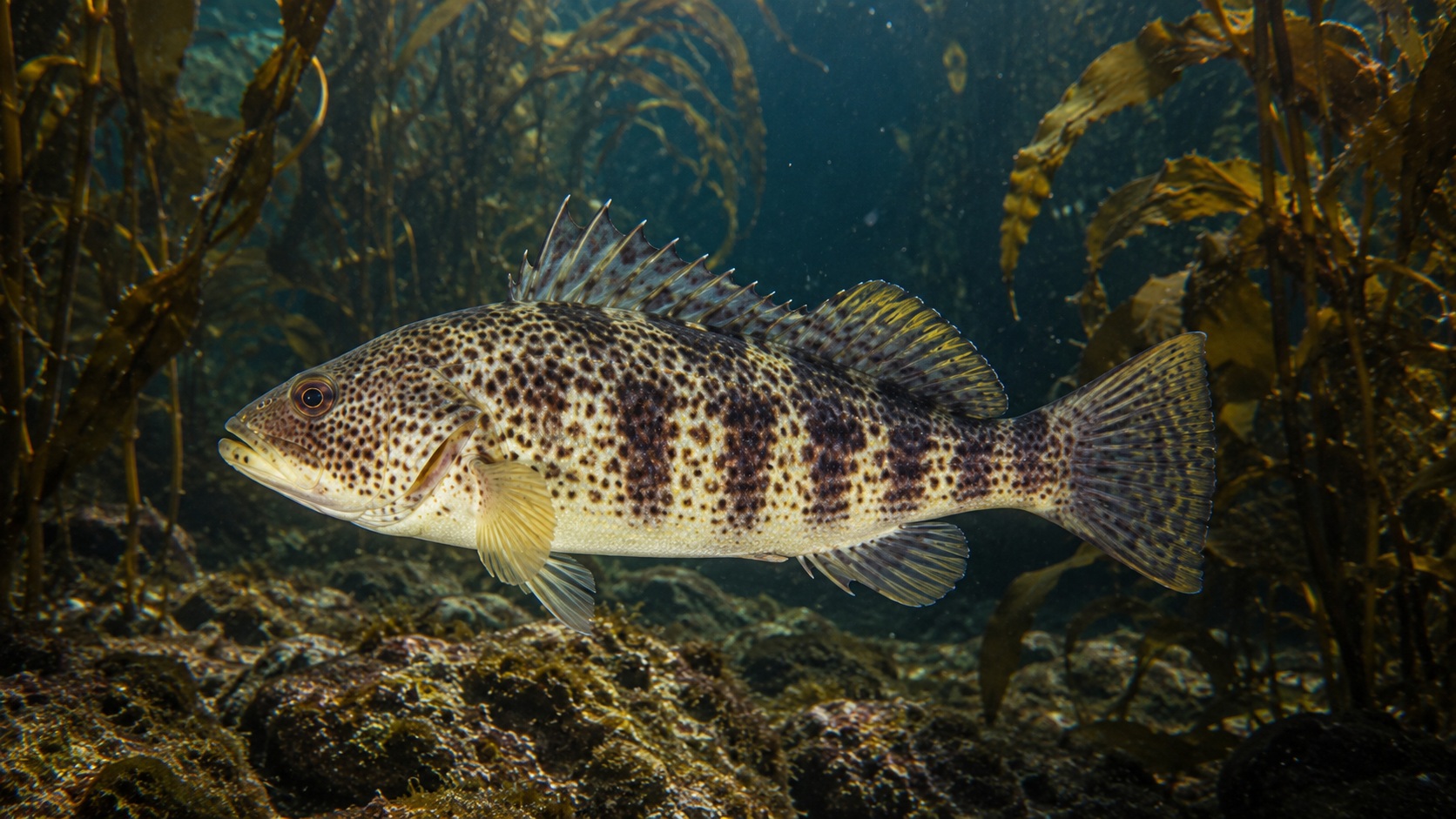
The spotted bay bass is a member of the sea bass family (Serranidae) and one of the three Southern California “bass” in the genus Paralabrax, alongside the kelp bass and the barred sand bass. It is a stocky, big-mouthed fish with the family’s notched dorsal fin, colored olive to gray-brown on the back and fading to a pale belly.
The giveaway is the spots. The body, and especially the lower sides and belly, is covered in round dark spots — a finer, more even spotting pattern than the bold irregular blotches of a calico (kelp bass). Spotted bay bass also often show faint darker bars along the upper sides, which is where the alternate name “spotted sand bass” comes from. Compared to the barred sand bass, the spottie’s spots extend well onto the belly and its rear dorsal-fin spines are noticeably longer and more uneven.
Most fish you catch run 10 to 16 inches. A keeper-sized fish at 14 inches is a solid spottie, and anything over 3 pounds is a genuine trophy worth a photo and a careful release.
Where to find them
Spotted bay bass range from central California south through Baja and into the Gulf of California, but their stronghold — and the heart of the fishery — is the bays and estuaries of Southern California. Unlike kelp bass, which want cool, clean, open-coast structure, spotties thrive in warm, sometimes turbid, brackish-influenced bay water. That tolerance is exactly why they are so accessible.
They are ambush predators glued to structure and edges. Look for:
- Eelgrass flats in 3 to 15 feet — the classic spottie habitat. Fish the edges and the potholes within the grass.
- Channel edges and drop-offs where a flat falls into deeper water. Fish stage on these breaks and feed on the current.
- Hard structure — riprap, jetties, bridge and pier pilings, dock floats, moored boats, and rock walls. Any shade line or hard edge in a bay can hold fish.
- Mud and sand bottom near structure, where they sit and wait for shrimp, crabs, and small baitfish.
The big three San Diego bays (San Diego Bay, Mission Bay), the Newport Back Bay, Anaheim Bay/Huntington Harbour, and the bays and harbors up and down the SoCal coast are all reliable. If you are not getting bit, move tighter to an edge — a grass line, a piling, the lip of a channel — rather than fishing open mud.
When to go
Spotted bay bass can be caught year-round, which is a big part of their appeal, but the fishing is best in the warmer months.
- Spring (April–June): Excellent. Fish move shallow and feed aggressively ahead of the summer spawn. Pre-spawn fish stack on flats and channel edges.
- Summer (July–September): Peak season. Warm bay water, abundant bait, and fish feeding hard and shallow. This is prime time for numbers and for sight-fishing shallow flats.
- Fall (October–November): Still very good as fish feed up before winter, often with a better average size.
- Winter (December–March): Slower but far from dead. Fish pull off the shallow flats toward deeper channel edges and holes. Slow your presentation down and fish the warmest part of the day.
Tide is the single most important variable. Moving water — especially the first hours of an incoming or outgoing tide — pushes bait against structure and switches the fish on. A slack tide in the middle of the day is the toughest window. Plan your trip around a tide change.
What to throw
Spotted bay bass eat shrimp, crabs, small fish, and worms, and they are suckers for a well-presented soft plastic. This is a light-tackle, finesse-friendly fishery.
Soft plastics (the go-to):
- Three to four inch swimbaits and paddle-tails on a 1/8 to 3/8 oz leadhead, matched to depth and current, are the standard. Natural, shrimp, and bait colors shine in clear water; darker and brighter colors work in stained bay water.
- Creature baits, split-tail grubs, and small worms rigged on a leadhead or a drop shot are deadly on pressured or sluggish fish.
- Work them slowly along the bottom with a lift-drop or a slow swim, keeping contact with the structure. Most bites come on the fall.
Live and natural bait:
- Live shrimp, ghost shrimp, and small live baits fished on a Carolina rig or under the float near structure are extremely effective and very beginner-friendly.
- Cut squid and market shrimp will catch fish soaked near a piling or channel edge.
Tackle: A 7 to 7-foot-6 medium or medium-light spinning rod with 10 to 20 lb braid and a 10 to 15 lb fluorocarbon leader is ideal. Spotties dive straight for cover when hooked, so enough backbone to turn a fish away from a piling or grass mat matters — but the bites can be subtle, so you want a sensitive tip. This is a fishery where a kayak or a small skiff shines, though plenty of fish are caught from shore, docks, and jetties.
Regulations
Regulations are set by the California Department of Fish and Wildlife (CDFW) and change periodically. Always verify current rules at wildlife.ca.gov before your trip.
As of 2026:
- Minimum size: 14 inches total length
- Daily bag limit: 5 fish per day, combined across the three California saltwater bass (spotted sand bass, barred sand bass, and kelp bass in any combination)
- Season: Open year-round
- License: A valid California sport fishing license is required for anglers 16 and older
The combined five-fish limit across all three bass species is the key rule to remember: a mixed bag of spotties, sand bass, and calicos still tops out at five. These limits were tightened to protect slow-growing, heavily pressured nearshore bass populations, so treat the resource with care.
Handling and release
Spotted bay bass are the backbone of a passionate catch-and-release sport fishery in Southern California’s bays, and they handle release well when treated right.
- Use wet hands or a rubberized net; a dry grip strips the protective slime coat.
- Keep air exposure short — back in the water within 30 seconds for a photo.
- Support the fish horizontally rather than hanging it vertically by the jaw, especially larger fish full of spawn in summer.
- Most spotties are caught in shallow bay water and do not suffer barotrauma, so they typically swim off strongly. If a fish is tired after burrowing into structure, hold it upright in moving water until it kicks away on its own.
Because the fishery is shallow, accessible, and heavily fished, many SoCal anglers release every spottie they catch. It keeps the bays full of fish for the next trip.
On the Table
Spotted bay bass are good eating — mild, sweet, white flesh much like their kelp bass and sand bass cousins — but the strong catch-and-release culture around them means most anglers let them go. A legal fish kept within the bag limit makes a clean, versatile fillet.
Taste and texture: Mild and slightly sweet, with firm white flesh and a medium flake. No strong fishy or briny character. The firm texture holds together well on the grill or in a pan.
Best preparation methods:
- Pan-frying: Dredge fillets lightly in seasoned flour and fry in butter or oil over medium-high heat; finish with lemon.
- Tacos: Lightly battered and fried pieces make excellent fish tacos — the firm flesh keeps the taco from going soggy.
- Grilling: Skin-on fillets handle the grill well; brush with oil, season simply, and top with salsa or chimichurri.
- Ceviche: The firm, mild flesh cures cleanly in lime without turning mushy.
Handling for table quality: Bleed and ice the fish promptly. Avoid letting it die and warm in a livewell, which softens the flesh. Remove the pin bones along the lateral line for clean, boneless fillets.
Eating caveats: Keep only what you will eat, and remember the combined five-fish bass limit and 14-inch minimum. Onboard filleting rules in California require fillets to retain a patch of skin for species identification. Ciguatera is not a concern in cool temperate California bay waters.