A note about links: If we include links to retail sites like Amazon or Bass Pro Shops, it's because they're relevant to the topic and, as anglers ourselves, we believe they're worth checking out. As an Amazon Associate we earn from qualifying purchases.
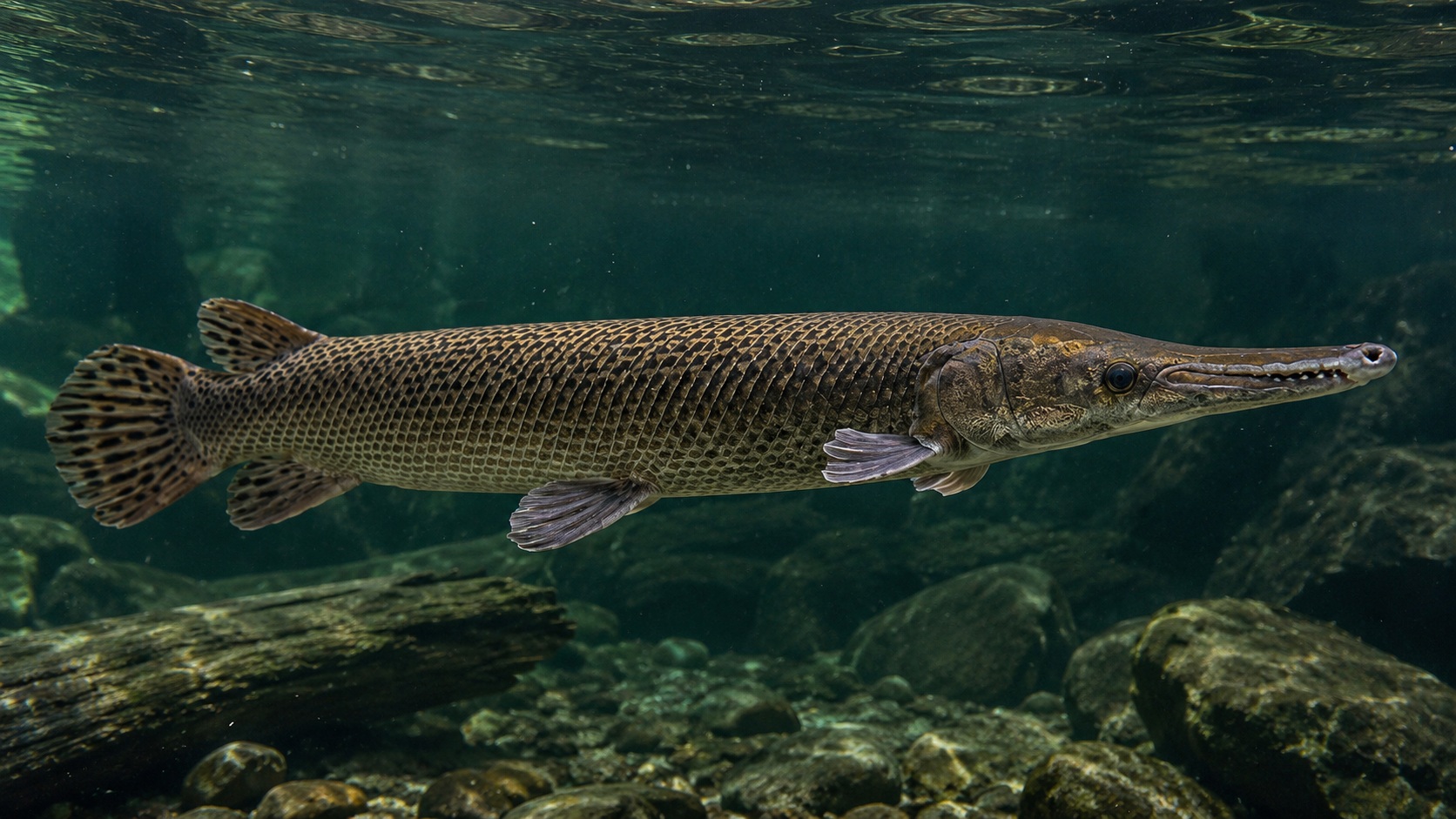
The first time you see a large alligator gar in the water, the instinct is to back up. The head is broad and flat, the jaws are lined with two rows of long, fang-like teeth on each side, and the overall silhouette — in turbid river water — looks enough like an actual alligator that the mistake is understandable. This is not a small, odd-looking bycatch fish. A mature alligator gar can be longer than a kayak, weigh more than most grown adults, and will comfortably eat prey the size of a small dog.
They are the largest freshwater fish in North America that are not sturgeons. They are also, in a genuine conservation success story that most people outside of the Gulf Coast have not heard, recovering from near-total collapse — and increasingly, anglers are targeting them on purpose.
What You Are Looking At
Alligator gar are distinguished from all other gar by two features visible at a glance. First, the snout: broader, flatter, and more duck-billed than the needle-like snout of longnose or spotted gar, with a distinctly alligator-like shape that gives the species its common name. Second, two rows of large teeth on the upper jaw rather than one. All other North American gar have a single row of teeth on the upper jaw; the alligator gar has two. If you can see the teeth clearly, that double row is the definitive ID.
The body is massive and cylindrical, covered in hard interlocking ganoid scales. The coloration ranges from olive to brown on the back, fading to a yellowish-white or cream-colored belly. Large adults often show a mottled or darkened appearance from years of river sediment and age. Like other gar, they surface periodically to gulp air using their swim bladder as a supplemental lung, which means an enormous fish breaking the surface in a big river impoundment is often an alligator gar.
Where They Live
Alligator gar occupy the lower Mississippi River drainage and the major Gulf Coast river systems of Texas, Louisiana, Arkansas, Mississippi, and Oklahoma. The Texas rivers — the Trinity, Sabine, San Jacinto, and Guadalupe — hold some of the best populations on the continent. In Louisiana, the Atchafalaya Basin is a stronghold. Arkansas and Mississippi have recovering populations in their larger river systems.
These fish are at home in the biggest, warmest, slowest water available. They favor large rivers, backwater lakes, oxbow lakes (old river bends cut off from the main channel), and reservoirs with warm, turbid water. Unlike longnose gar, which are comfortable in clear, well-oxygenated lakes, alligator gar do well in low-oxygen environments because they can breathe air directly. They are also tolerant of brackish and even saltwater, occasionally moving into coastal estuaries along the Gulf of Mexico.
Deep river bends, submerged timber, and broad shallow flats adjacent to the river channel are productive locations. They are not fast-current fish — look for the slow, deep sections.
A Conservation Comeback Story
Through most of the 20th century, alligator gar were considered trash fish and actively exterminated by fisheries managers who believed, incorrectly, that they competed with sport fish and reduced game fish populations. Electrofishing surveys, netting operations, and bounty programs reduced their numbers drastically across much of their range. By the 1980s and 1990s, they had disappeared from large portions of their historic habitat.
The scientific understanding of gar’s role in the ecosystem eventually changed. Research showed that gar primarily eat rough fish, invasive carp, and sick or slow prey — not the healthy sport fish populations managers feared. States began reversing course, implementing size limits, bag limits, and alligator gar stocking programs. Texas, in particular, made significant investments in alligator gar restoration beginning in the early 2000s. The results have been measurable. Populations in Texas, Louisiana, and Arkansas have responded, and the species is now considered stable enough to support a carefully managed recreational fishery.
This is the fish that was nearly gone from the continent within living memory and is now the subject of guide trips on Texas rivers. That context matters when you encounter one.
Tackle and Approach
This is an advanced fish to target deliberately. The gear requirements are substantial: heavy conventional or baitcasting tackle, 60- to 100-pound braided line, heavy-gauge steel leaders of at least 12 inches (monofilament will not survive contact with those teeth), and large hooks — 8/0 to 12/0 circle hooks are common. Live bait in the 10- to 16-inch range (common carp, buffalo, or large shad) is the standard approach for large fish. The bait is typically fished on a float rig or free-lined in slow current.
The same hookset problem that plagues longnose gar applies here, amplified by scale. The bony, tooth-lined mouth needs time and proper hook placement. Many guides use a rope lure or frayed nylon rig for smaller fish; for large targeted gator gar, a large circle hook positioned well back in the bait and a 45- to 60-second wait before the hookset is the standard method.
Bowfishing is also a legal and popular method for alligator gar in Texas, Louisiana, and other Gulf Coast states. Check regulations carefully before fishing — alligator gar have specific size limits, bag limits, and gear restrictions in most states where they are managed.
Handling a Big Fish Safely
A 100-pound alligator gar is a significant animal. Bringing one to the boat requires a calm, controlled approach. Those teeth are long and oriented to grab and hold prey; a thrashing fish near the gunwale is a serious hazard. A large, knotless rubber net is the safest landing tool. Keep fingers and hands away from the mouth at all times, use de-hooking pliers, and if you are releasing the fish (which is increasingly encouraged for large, older individuals), support the fish horizontally in the water until it swims off on its own.
Never put a large alligator gar in the bottom of a small boat and expect it to hold still. These fish are powerful enough to cause real damage to equipment and people.
Roe is toxic. The eggs of alligator gar, like all gar species, contain ichthyotoxin and are poisonous to humans and mammals. Do not eat the roe. Do not let dogs eat discarded eggs. Dispose of roe away from pets and children.
Can You Eat It?
Yes, and the answer surprises most people who ask. Alligator gar flesh is white, mild, and flaky — comparable to grouper or redfish, with a clean flavor and firm texture that holds up to most cooking methods. Pan-frying, baking, and smoking all work well. The meat is free of the excessive boniness that makes longnose gar difficult, though care at the cleaning table is still required given the thick scales and tough skin.
The ganoid scales essentially require a hatchet or heavy knife to cut through. Many people fillet from the inside out or use heavy shears. Once the fillet is free of scales and skin, the edible meat is quite good — good enough that several Texas fishing guides specifically market alligator gar as table fish rather than pure catch-and-release trophies.
Eatability is good. Effort to get there is high. The result is worth it.