A note about links: If we include links to retail sites like Amazon or Bass Pro Shops, it's because they're relevant to the topic and, as anglers ourselves, we believe they're worth checking out. As an Amazon Associate we earn from qualifying purchases.
What just bit your line?
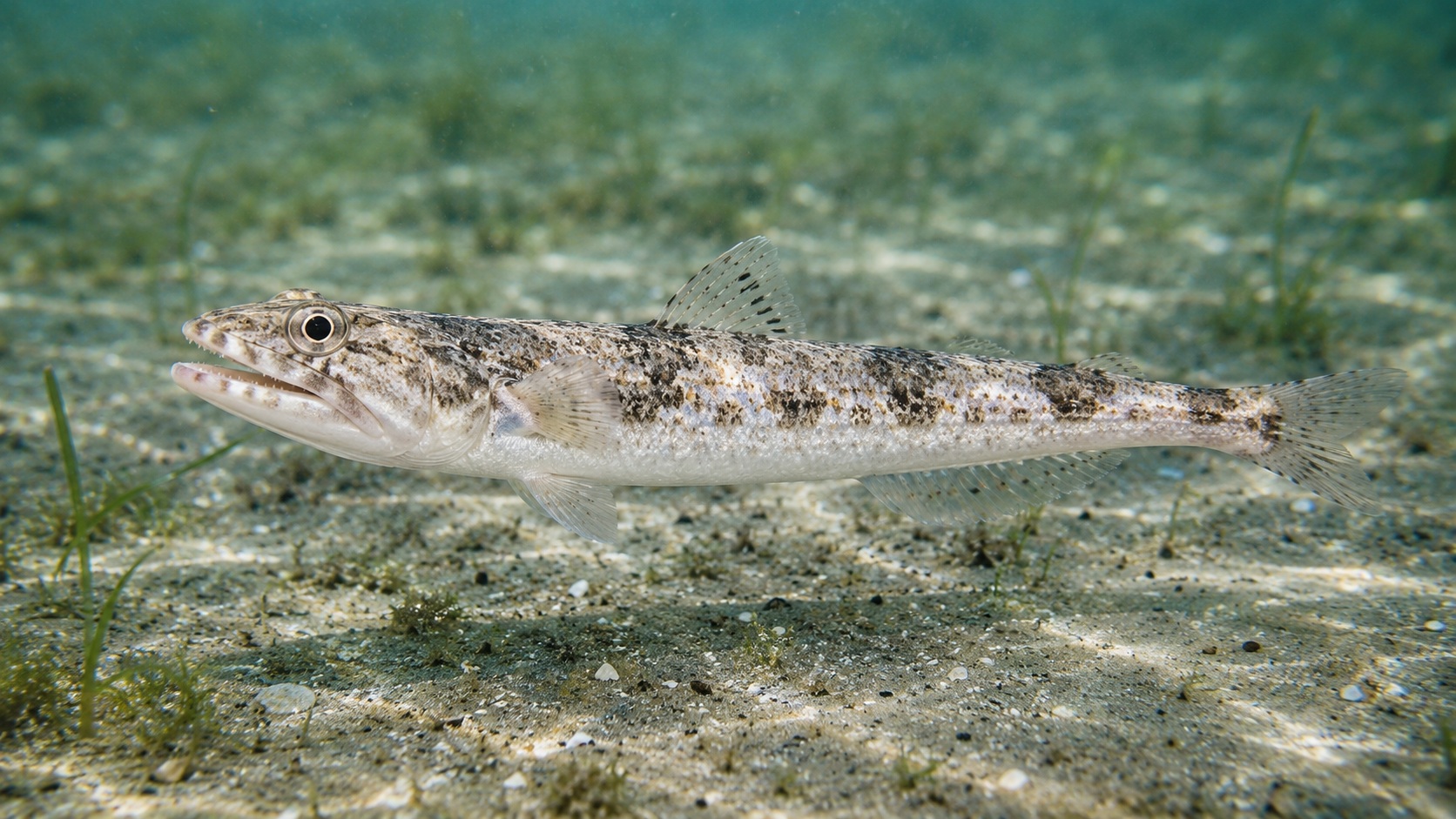
You were fishing a grass flat or sandy bottom, your bait hit the sand, and something hit it hard. You pulled up what looks like it crawled out of a fossil record: long, slender body, flat lizard-like head, and a mouth full of tiny needle-sharp teeth pointing backward like a trap. That is the inshore lizardfish, Synodus foetens, and it is one of the most common accidental catches along the Atlantic and Gulf coasts. It grabbed your bait or lure because that is exactly what it does for a living. It sits motionless on the bottom, sometimes half-buried in sand, and ambushes anything that swims close enough. You are not the first angler to hold one of these up with a puzzled look. The good news is it is harmless as long as you handle it right, and releasing it back to the bottom takes about fifteen seconds.
How to identify one
The inshore lizardfish is almost impossible to mistake once you know what you are looking at. The body is long and cylindrical, like a cigar, tapering toward the tail. The head is distinctly flat and triangular, wider than the body behind it, with large eyes set high and slightly back. The mouth is wide and extends well past the eyes, and when you look inside you see the feature that gets everyone’s attention: row after row of small, needle-like teeth covering the jaws and even the tongue. Some of those teeth can fold back, which makes biting down easy but extracting anything difficult.
The coloration runs sandy to olive-brown with a mottled or faintly streaked pattern along the sides, which provides near-perfect camouflage against the sandy and grassy bottoms it prefers. Most catches fall between 10 and 14 inches, though fish up to 18 inches are caught regularly in warmer months. There is a small adipose fin between the main dorsal fin and the tail — that small, fleshy, rayless fin you also see on trout and catfish — which is a reliable identification marker.
Confusion species are rare because the body shape is so distinctive. In some areas, anglers briefly mistake small lizardfish for young needlefish or juvenile snake eels. The key differences are the flat, triangular head and those backward-curving teeth; needlefish have long, beak-like jaws, and eels have smooth, cylindrical bodies without scales. Once you have seen a lizardfish, you will recognize it immediately on every catch after that.
Is it dangerous?
The inshore lizardfish is not dangerous in any serious sense, but those teeth will draw blood if you are careless. The teeth curve backward, meaning anything they contact gets pulled in rather than pushed away. A mishandled lizardfish can leave a series of small, painful lacerations across your fingers before you realize what happened. The fish is not venomous. There are no spines, no toxins in the flesh, no sting, and no slime beyond the normal. The only real hazard is the mouth.
To handle one safely, grip it firmly just behind the head with your thumb and forefinger wrapped around the body, the same way you would pin a bass or a trout. Keep your fingers well back from the jaw. The fish will wriggle, but it is not aggressive; it is just trying to get back in the water. Use needle-nose pliers or a dehooker to remove the hook rather than working bare-handed next to the mouth. If the hook is deeply swallowed, cut the line close rather than digging for it — the hook will rust out in saltwater and the fish will fare better than if you spend a minute with forceps near its throat. Release by lowering the fish to the waterline, opening your grip, and letting it go. It will dive straight back to the bottom.
Where it comes from
The inshore lizardfish is a year-round resident of the Atlantic coast from Massachusetts south through the Caribbean and along the entire coastline of Brazil, plus the full extent of the Gulf of Mexico. It thrives in shallow coastal waters: grass flats, sandy and muddy bottoms, tidal creeks, and estuaries are all home territory. You will regularly catch it in the same spots where you target spotted seatrout, flounder, and redfish, because all of these species share the same shallow inshore habitat. Water depth for most catches ranges from two to thirty feet, though the species extends to around 100 feet offshore.
The lizardfish is a textbook ambush predator. It settles on the bottom, often pointing its head slightly upward at an angle, and holds completely still. Sometimes it buries itself shallowly in sand so that only the head and eyes are visible. When a baitfish, shrimp, or small crustacean passes within range, it strikes explosively and swallows quickly. This hunting style is precisely why it lands on your hook so often: a lure or bait worked near the bottom with any kind of erratic or darting motion looks exactly like the prey this fish has been waiting for. Warm months from spring through fall see the highest catch rates as lizardfish become more active in shallower water, but they are present year-round in the southern part of their range, including throughout Florida and the Gulf states.
On the table
The inshore lizardfish earns its poor eatability rating honestly. The fish is technically edible, and people in parts of Central America and the Caribbean do eat it regularly, but most recreational anglers in the United States find it not worth the trouble. The central problem is bones. The lizardfish has an unusually dense network of small pin bones distributed throughout its flesh, far more than most common food fish. These are not simply the Y-bones you navigate around in a trout or shad; they run through the meat in multiple layers and are difficult to remove without destroying the fillet in the process. The flesh itself is white, mild, and not unpleasant in flavor, but the texture can run soft compared to species like snook or redfish.
If someone in your group is determined to eat one, the two most practical approaches are frying it whole or making fish stock. For whole frying, gut the fish, score the flesh on both sides with deep diagonal cuts every inch or so, season it, and fry it hot. The smaller bones cook down to the point where you can crunch through them, similar to how small whole fish are eaten in many coastal cuisines. For stock, the bones are not a problem at all; simmer the cleaned carcass with aromatics for 45 minutes and strain. Either way, the fish needs to be at least eight inches to give you anything worth cooking. The honest answer for most situations is to take a quick look at this prehistoric-looking creature, appreciate it for what it is, and put it back.
What to do with it
Getting a lizardfish unhooked and back in the water quickly is the goal. Start with a tool rather than bare hands. Needle-nose pliers or a standard dehooker work well; grip the bend of the hook and back it out with a twist. If the fish has the hook buried shallowly in the lip, this takes five seconds. Keep the fish low over the water or on a wet surface while you work — these fish are tough, but there is no reason to hold them in the air longer than necessary.
To keep a grip on the fish during hook removal, place your thumb and forefinger just behind the gill plate and pectoral fins, squeezing gently but firmly. The lizardfish is not slimy in the way that makes it hard to hold, but it will push and thrash, so do not use a loose grip. Keep your palm and other fingers away from the mouth. Once the hook is free, lower the fish back to the water at the surface. You do not need to revive it or hold it upright the way you might with a tired tarpon; lizardfish are resilient bottom fish and will swim off on their own immediately. Drop it, let it go, and get your bait back in the water.