A note about links: If we include links to retail sites like Amazon or Bass Pro Shops, it's because they're relevant to the topic and, as anglers ourselves, we believe they're worth checking out. As an Amazon Associate we earn from qualifying purchases.
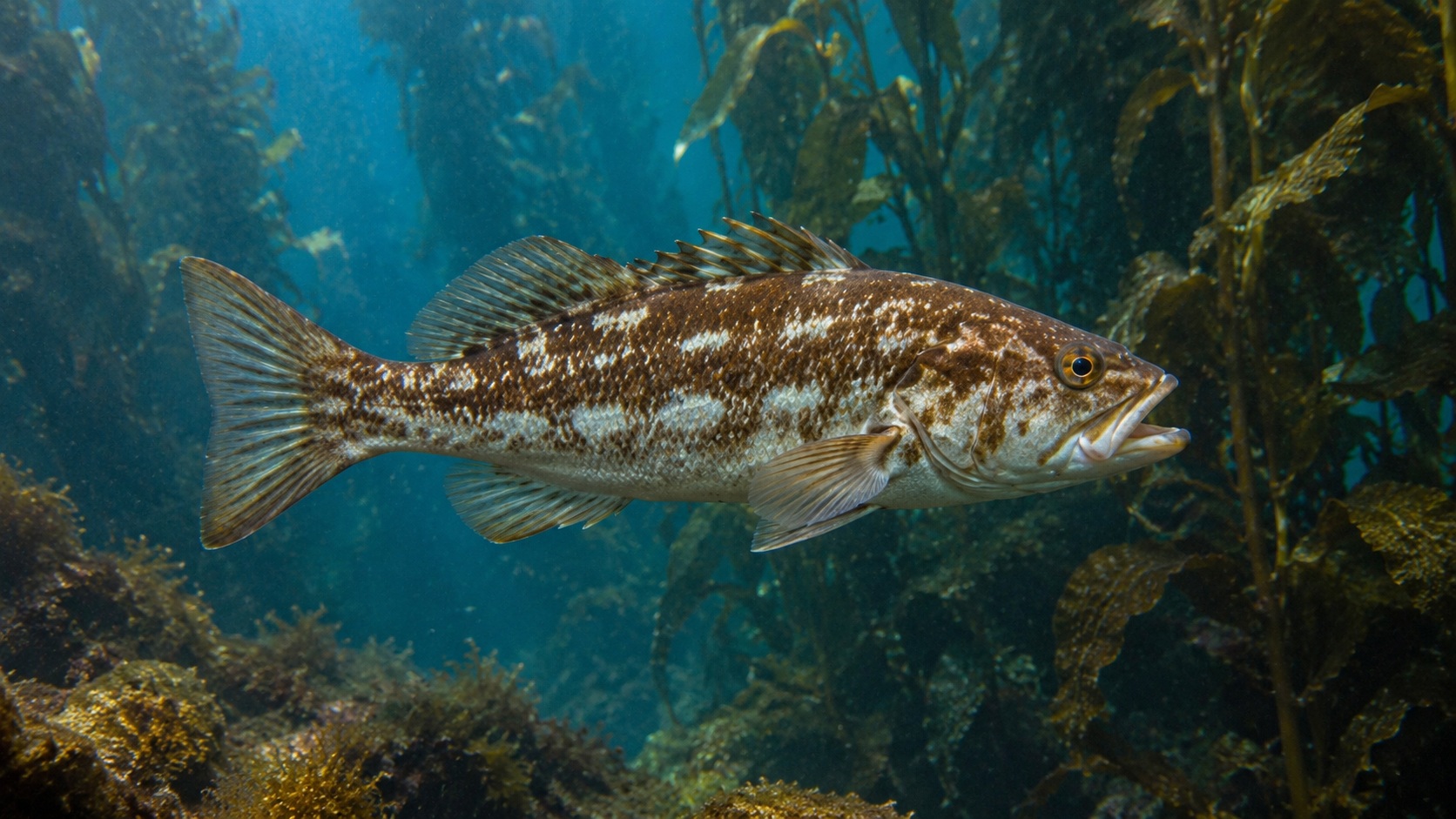
Few fish define the Southern California fishing experience quite like the kelp bass. Known affectionately as the calico bass for the bold mottled pattern stitched across its flanks, this species lives in the heart of the kelp forest — that cathedral of amber light filtering down through towering giant kelp canopies just off the coast. Working a plastic swimbait through a kelp edge at first light, watching a thick-shouldered calico materialize out of the structure to engulf it, is a moment every SoCal angler knows. The fish fights hard for its size, runs for cover the instant it feels the hook, and rewards anglers who learn to read structure and work it patiently. It is the nearshore bass of the Pacific.
How to identify one
Kelp bass are stocky, deep-bodied fish with a large mouth and the classic notched dorsal fin shared by the sea bass family. The coloration is what earns the “calico” name: an irregular patchwork of olive, brown, tan, and pale blotches across the back and sides, fading to a lighter belly. The blotches are distinct and irregular, not stripes or uniform spots. A key identifying mark is the third, fourth, and fifth dorsal spines — they are roughly equal in length, giving the front dorsal fin a flat-topped profile that differs from related sand bass species.
Compared to the barred sand bass, kelp bass have no obvious vertical bars, a deeper body, and a preference for rocky and kelp structure rather than sandy flats. Compared to spotted sand bass, kelp bass are generally larger and lack the distinct spotting pattern on the lower body. Most keeper fish run 14 to 18 inches and 1 to 3 pounds, though fish over 5 pounds are caught regularly in productive kelp beds. The IGFA all-tackle world record stands at 14 lbs 7 oz, caught by Thomas Murphy at Newport Beach, California in 1993.
Where to find them
Kelp bass are endemic to the eastern Pacific coast, ranging primarily from the U.S.-Mexico border north to the San Francisco Bay Area, with their core range and highest densities in Southern California. They are a resident species tied tightly to hard structure and macroalgae habitat.
The best locations are:
- Kelp forests along the Southern California coast, from Santa Barbara south through San Diego and into Baja. The outer edge of the canopy and interior holes in the kelp are the top zones.
- Rocky reefs in 10 to 70 feet of water. Look for irregular boulders, ledges, and crevices that give fish a place to ambush prey and retreat to cover.
- Artificial structure including oil platforms, jetties, breakwaters, and bridge pilings. The Channel Islands, Catalina Island, and the reefs off Point Loma and Palos Verdes are legendary calico fisheries.
- Shallow structure in 5 to 20 feet near the surface during summer, when water warms and baitfish are abundant in the canopy itself.
Kelp bass are almost always holding tight to some piece of structure. If you are not getting bit, move closer to the kelp stalk, the reef top, or the shadow edge rather than fishing open water.
When to go
Kelp bass can be caught year-round in Southern California, but productivity peaks from late spring through fall. Water temperature is the primary driver.
- Spring (April-May): Fish become increasingly active as water warms past 58 degrees. Kelp growth accelerates and bait moves in. Pre-spawn fish begin staging on structure.
- Summer (June-August): The peak season. Warm water, abundant bait, active fish at all depths including shallow. Night fishing produces some of the largest fish of the year as big calicos move up into the kelp canopy to feed on mackerel and anchovies.
- Fall (September-November): Excellent fishing continues through fall, often with larger average fish as summer spawning ends and fish are feeding aggressively to build condition before winter.
- Winter (December-March): Fish are catchable but slower. Target deeper structure in 30 to 70 feet on warmer days. The fish are still there but need a slower, more deliberate presentation.
Tidal movement matters year-round. Moving water concentrates bait against structure and triggers feeding. The first two hours of a significant tidal change — especially an outgoing tide pulling bait off kelp beds — is consistently productive.
What to throw
Kelp bass are opportunistic predators that eat a wide variety of prey. They respond to both live bait and artificial presentations.
Live bait:
- Anchovies and sardines are the traditional standard. A live anchovy fished on a Carolina rig or a sliding sinker rig just above structure is hard to beat.
- Mackerel, queenfish, and small green perch work well for larger fish.
- Live squid on a short-drop just above reef structure is deadly, especially at night.
Soft plastics:
- Paddle-tail swimbaits in the 3 to 5 inch range are the most versatile artificial. White, pearl, and natural anchovy colors on a 1/4 to 3/4 oz jig head allow you to match depth and current.
- Straight-tail and curl-tail grubs in chartreuse, watermelon, and motor oil work well on slower days.
- Drop-shot rigs with a small finesse worm or straight tail grub produce fish when they are pressured or inactive.
Hard baits:
- Irons (cast metal jigs) are a classic Southern California technique. Let them flutter on a free-spool drop or work them with an erratic jerk retrieve near structure.
- Small to medium surface iron and poppers work during top-water feeds in summer.
Tackle: Medium to medium-heavy spinning or baitcasting gear handles most situations. A 7 to 7.5 foot rod with 15 to 20 lb braid and a 15 to 20 lb fluorocarbon leader covers everything from shallow kelp work to jigging deeper structure. Go heavier if you are fishing near gnarly reef or fighting fish out of thick kelp — this species will dive straight into cover the moment it is hooked.
Regulations
Regulations are set by the California Department of Fish and Wildlife (CDFW) and are subject to change. Always verify current rules at wildlife.ca.gov before your trip.
As of 2026:
- Minimum size: 14 inches total length
- Daily bag limit: 5 fish per day (kelp bass, barred sand bass, and spotted sand bass in any combination)
- Season: Open year-round
- Range: Regulations apply to California state waters; the species is primarily caught south of Point Conception
A valid California sport fishing license is required. Anglers fishing from a licensed party/charter boat may be subject to the same bag limits. The combined bag limit for the three California saltwater bass species means that if you have already kept 5 bass of any mix, your calico bass fishing for the day is done. These bag limits were tightened in recent years to address declining bass populations in heavily pressured nearshore zones, so fish responsibly.
Handling and release
Kelp bass are a hardy nearshore species that can tolerate careful catch-and-release handling well, though they are also a prized table fish and legal-sized fish are commonly kept within the bag limit.
For fish you plan to release:
- Use a wet hand or a rubberized net when handling. A dry hand removes the protective slime coat and increases infection risk.
- Minimize air exposure. A fish held out of water for a photo should be back in the water within 30 seconds.
- Kelp bass do not suffer from barotrauma as severely as deep-water species because most are caught at moderate depths, but fish brought up quickly from 40 or more feet may show a distended stomach. Give these fish a moment at the surface in the water before releasing rather than tossing them back immediately.
- Support the fish horizontally with two hands rather than gripping the jaw vertically under the weight of the body.
- For fish that appear lethargic after the fight, hold them gently facing into any current and move them slowly back and forth until they kick away strongly on their own.
For fish you intend to keep, a quick bleed and ice will preserve quality. Kelp bass are excellent table fish with white, firm, mild flesh well suited to grilling, frying, and tacos.
On the Table
Kelp bass (calico bass) is underrated table fare — most Southern California anglers practice catch-and-release given the species’ slow growth and dedicated sport-fishing culture, but those who do keep a legal fish find genuinely good eating with firm, clean white flesh.
Taste and texture: The meat is mild and slightly sweet with no strong briny or fishy character. Flesh is white, firm, and medium-flaked — closer to black sea bass or striped bass than to a soft, delicate fillet. The firmer texture holds up well to high-heat cooking without falling apart.
Best preparation methods:
- Pan-frying: The go-to for most calico bass keepers. Dredge skin-on fillets lightly in seasoned flour and fry in butter or neutral oil over medium-high heat. The skin crisps well and the firm flesh stays together cleanly. Finish with lemon.
- Ceviche: A post-dive tradition along the Southern California coast. Dice raw fillets into half-inch cubes, cure in fresh lime juice for 20-30 minutes, and fold in onion, tomato, cilantro, and serrano or jalapeno. The mild, firm flesh takes citrus acid evenly without going mushy.
- Grilling: Skin-on fillets or butterflied portions handle medium-high grill heat without sticking or falling through the grate. Brush with olive oil, season simply, and grill 4-5 minutes per side. The mild flavor benefits from char and a chimichurri or salsa verde.
- Tacos: Fish tacos are a local staple. Lightly battered and fried pieces work especially well; the firm texture prevents the taco from becoming soggy.
Handling for table quality: Kelp bass hold up reasonably well but benefit from prompt care. Bleed the fish immediately after landing by cutting the gill arch, then place it on ice or in a slurry. Avoid letting the fish die and warm in a livewell for extended periods — the flesh softens noticeably. Fillets are clean and boneless once the pin bones near the lateral line are removed; the skin peels easily if desired after cooking.
Eating caveats:
- Bag and size limits: California regulations set a 14-inch minimum total length and a combined bag limit of 5 fish per day (kelp bass, barred sand bass, and spotted sand bass in any combination). Onboard filleting rules require fillets of at least 7.5 inches with a 1-inch square of skin intact for species identification. Keep only what you intend to eat; the species is a slow-growing reef resident with significant local conservation attention.
- Ciguatera: Kelp bass range from the California coast into northern Baja. Ciguatera risk is negligible in these cooler, temperate waters — the dinoflagellate responsible for ciguatera toxin does not establish in Pacific California reef systems the way it does in tropical Atlantic and Indo-Pacific reefs.