A note about links: If we include links to retail sites like Amazon or Bass Pro Shops, it's because they're relevant to the topic and, as anglers ourselves, we believe they're worth checking out. As an Amazon Associate we earn from qualifying purchases.
There is no other freshwater fish in Florida quite like the butterfly peacock bass. When one of these jewel-bright cichlids erupts on a topwater lure in a sun-drenched Miami canal, the strike is so violent and the colors so vivid that first-time anglers often stand speechless for a moment before setting the hook. Introduced into South Florida canals in 1984 to control invasive cichlids, the peacock quickly became the region’s most sought-after urban sportfish. A fish that fuses tropical beauty with a largemouth-level appetite, it is as approachable as any canal bass and more visually rewarding than almost anything else you can catch in the state.
How to identify one
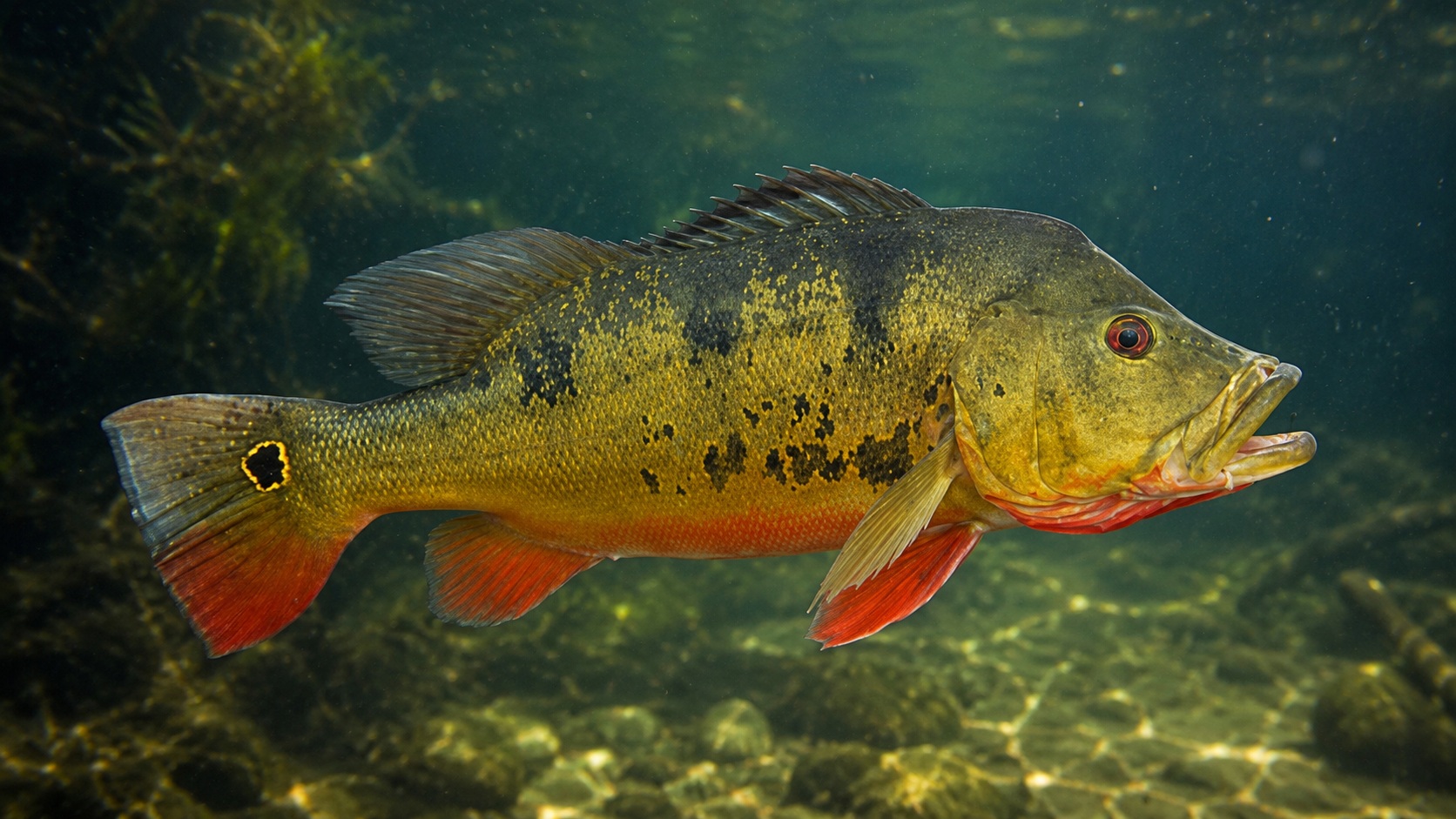
The butterfly peacock is unmistakable once you have seen one. The body is olive to golden-yellow with three dark vertical bars or saddles along the sides, and the most reliable field mark is the large black ocellus (eye spot) ringed in yellow or gold, positioned on the base of the tail fin. The belly flushes from yellow to orange, and the overall pattern intensifies during spawning. Breeding males develop a pronounced forehead hump that can make a big fish look almost prehistoric. No other Florida freshwater species shares this combination of markings. The oscar, another non-native cichlid found in the same canals, has a similar ocellus but a rounder body shape and lacks the bold barring. The speckled peacock bass (Cichla temensis), which grows much larger but is not established in Florida, has a pattern of scattered light spots rather than solid vertical bars. Size helps too: in Florida, a fish over 6 pounds is a genuine trophy and anything above 8 pounds is exceptional.
Where to find them
Butterfly peacock bass are confined almost entirely to the urban canal networks of Miami-Dade and Broward counties, with a growing presence in Palm Beach County. Cold intolerance keeps them south; water temperatures below 60 degrees Fahrenheit are lethal, and the fish cannot tolerate salinity above about 18 parts per thousand. Within their range, over 300 miles of fishable canals hold healthy populations. In Miami-Dade, the Tamiami Canal, Snapper Creek, Aerojet Canal, and Cutler Drain are consistently productive. Broward offers good numbers along the Hillsboro, Griffin Road, and Cypress Creek canal systems, and urban parks like Plantation Heritage, Markham, and Brian Piccolo all hold fish. The Palm Beach County C-51 (West Palm Beach Canal), Delray Canal (C-15), and the Ida-Osborne chain of lakes are worth the drive for anglers willing to cover new ground. Within any canal, target the shade: bridge pilings, culverts, canal intersections, dead-end branches, overhanging trees, and submerged structure concentrate fish throughout the year. Deep rock pits in the same region also hold peacocks and produce larger fish on average.
When to go
Peacock bass are year-round targets in South Florida because the climate rarely drops to dangerous temperatures, but fishing quality is not equal across all months. Spring is peak season. April through June aligns with the primary spawn and produces the most aggressive surface-feeding behavior. Spawning fish guarding nests in shallow, visible water are highly catchable and will strike anything that enters their territory. May and early June can deliver double-digit catch days in good canal sections. Summer fishing remains strong through September, though midday heat pushes fish deeper into shade. Fall (October through November) is underrated, as post-spawn fish are actively restoring energy. Winter is the slow period, but warm sunny afternoons still produce fish when air and water temperatures climb into the 70s. Critically, peacock bass do not feed at night. They are daytime, sight-oriented predators, so there is no benefit to fishing after dark. Midmorning through early afternoon on bright days is the single best window.
What to throw
Live shiners are the top producer for numbers and size. Use small, lively wild shiners in the 2 to 3-inch range, free-lined or under a float near structure. Peacocks key on the erratic action of a struggling shiner better than almost any artificial. For anglers preferring lures, the selection is wide and forgiving for a beginner.
Topwater plugs deliver the most spectacular strikes and are effective any time fish are active near the surface. Tiny Torpedoes, Pop-Rs, prop baits, and walking plugs in chartreuse, fire tiger, and natural shiner patterns all work. Walk the dog over canal intersections and shade lines in the morning.
Jerkbaits and minnow plugs like Rapala Original Floaters and Husky Jerks in natural shiner or gold patterns are reliable year-round. Work them with sharp twitches and pauses rather than a steady retrieve. Peacocks react to the pause, often hitting the lure on the drop.
Spinners and spinnerbaits in bright colors (chartreuse, orange-chartreuse, fire tiger) are excellent search baits for covering canal banks. Roostertail spinners in 1/8 to 1/4 oz are classic peacock lures, and the flash and thump trigger the fish’s competitive instinct.
Bucktail jigs in white, chartreuse, or natural colors, weighted at 1/8 to 1/4 oz, work especially well for sight-fishing spawning fish on beds. Cast past the nest and drag the jig slowly through the strike zone. Weedless rigs allow you to thread jigs through vegetation without hangups.
Fly gear produces memorable catches. Streamers imitating small baitfish, epoxy minnows, and foam poppers or pencil poppers in sizes 2 to 2/0 are the go-to patterns. Peacocks will chase and crash a popper with enough aggression to make even experienced fly anglers flinch.
Gear note: peacock bass have extremely abrasive mouths that will cut through light monofilament quickly. Use a short fluorocarbon leader of 20 to 40 lb test when fishing braided main line, or go straight monofilament at 15 to 20 lb. Light to medium-light spinning or baitcasting tackle in the 6- to 7-foot range handles canal fishing comfortably.
Regulations
Butterfly peacock bass in Florida are managed by the Florida Fish and Wildlife Conservation Commission (FWC). Current statewide rules are:
- Bag limit: 2 butterfly peacock bass per angler per day
- Size limit: Only 1 of the 2 fish may be 17 inches or longer in total length; there is no minimum size on the second fish
- License: A valid Florida freshwater fishing license is required for anglers 16 and older
- Important: Speckled peacock bass (Cichla temensis) are illegal to possess in Florida; confirm species identification before retaining any fish
Always verify current regulations at myfwc.com/fishing/freshwater/regulations/ before fishing, as rules are subject to change. The FWC actively encourages catch-and-release, especially for fish over 14 inches, to protect the quality of this self-sustaining introduced population.
Handling and release
Peacock bass are hardy fighters but benefit from careful handling when released. Grip the fish vertically by the lower lip (like a largemouth) or support it horizontally under the belly for larger specimens. The mouth is rough but not dangerous. Avoid squeezing the body, which can damage internal organs. Because peacocks are exclusively a catch-and-release sport fishery in practice (FWC actively encourages release), keep the fish in the water as much as possible before a quick photo and return. If you do choose to keep your legal limit, peacock bass are excellent table fare with firm, white, mild flesh comparable to snook. They respond well to simple preparations: pan-fried fillets with a light breading are a common choice among Miami-Dade locals who grew up fishing these canals. For release fish, hold them upright in the current or move them gently forward and back to restore oxygen flow before letting go.
On the Table
Peacock bass are genuinely good table fare — firm, white-fleshed, and mild — though most Florida anglers practice catch-and-release, and consumption advisories on South Florida canals add a real caveat worth knowing before you keep one.
Taste and texture: The flesh is white, low in oil, and carries a mild, slightly sweet flavor that draws frequent comparisons to snapper or grouper. Fillets are firm and hold together well during cooking, which makes this species forgiving across a range of methods. The flavor is clean without any strong gaminess, making it approachable even for people who do not regularly eat fish.
Best preparation methods:
- Pan-frying or shallow-frying: The firm fillet takes a light flour or breadcrumb crust extremely well. The crust crisps without the flesh falling apart, and the mild flavor lets simple seasoning — salt, pepper, lemon — do the work.
- Grilling: The density of the flesh holds up on a hot grill without needing a basket. A medium-high fire with a quick sear develops a good crust while keeping the interior moist; the mild sweetness pairs well with citrus or herb marinades.
- Baking or oven-roasting: A 400 F oven for 10-12 minutes produces clean results. The low oil content means the fish benefits from a light coating of butter or olive oil to prevent drying.
- Brazilian-style preparation (tucunare na pimenta): In its native Amazonian range, peacock bass is a genuine food fish eaten with chili, onion, and tomato. This spiced preparation respects the firm texture and complements the mild base flavor without overwhelming it.
Handling for table quality: Ice fish immediately after the catch. Peacock bass in warm South Florida canals will soften quickly if left in a warm livewell or on a stringer in the sun. Bleed the fish by cutting the gill arch right after catching if you intend to keep it. Fillets are clean and relatively easy to remove; the firm flesh means a sharp knife produces good results. Remove the lateral-line strip if you prefer the mildest possible flavor.
Eating caveats: Mercury accumulation is the primary concern for Florida fish. The Florida Department of Health has issued consumption advisories on multiple South Florida canals where peacock bass are caught, generally recommending limited meals per week rather than a full prohibition. Advisory status varies by specific waterway. Check the Florida DOH interactive fish advisory tool before keeping peacock bass from urban canals in the Miami-Fort Lauderdale corridor. Peacock bass are a freshwater cichlid with no documented ciguatera risk — ciguatoxin does not apply here. In their native South American range, no meaningful consumption concerns are reported.