A note about links: If we include links to retail sites like Amazon or Bass Pro Shops, it's because they're relevant to the topic and, as anglers ourselves, we believe they're worth checking out. As an Amazon Associate we earn from qualifying purchases.
What is it?
The fathead minnow (Pimephales promelas) is the backbone of the freshwater bait industry in the United States. Walk into virtually any bait shop from Maine to Montana, and you will find a tank of these small, stout minnows sold under names like tuffies, blackheads, or rosy reds. They are native across a huge swath of North America - from Quebec and the Northwest Territories down through the Great Plains and Mississippi River basin to Alabama and Texas - and have been introduced far beyond that range through bait bucket releases and stocking programs.
For anglers, the fathead matters for two reasons. First, it is the most available and affordable live bait you can buy or catch yourself, capable of drawing strikes from nearly every freshwater predator that swims. Second, it is a foundational forage fish in ponds and lakes throughout the country. Fishery managers stock them deliberately to feed bass, walleye, and pike - which means understanding this fish helps you read a body of water and predict where predators will be feeding. When you see a school of fatheads nervous at the surface, something bigger is almost certainly below them. For how to keep and fish them, see our minnows & shiners bait guide.
How to identify one
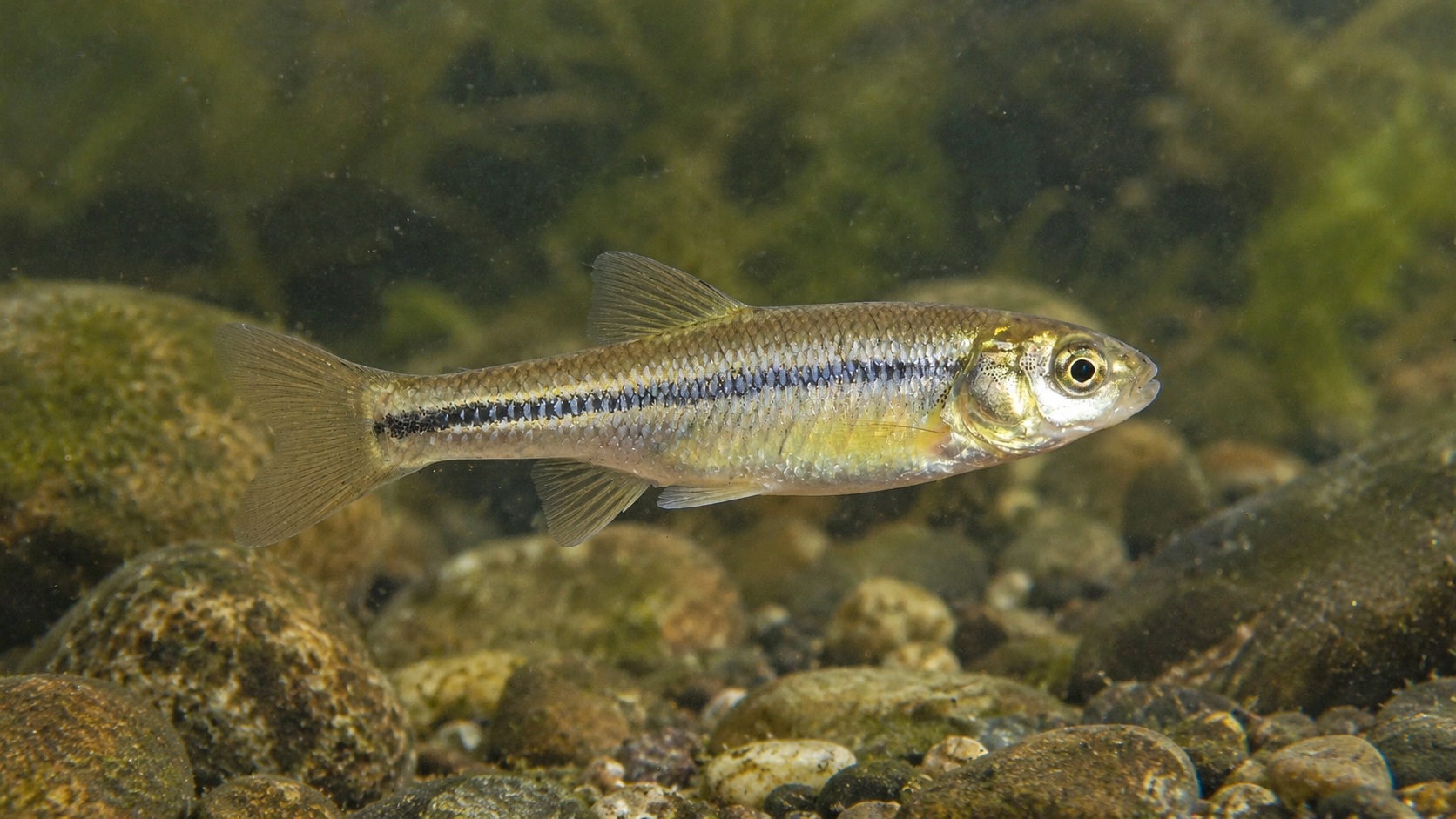
Fathead minnows are small and chunky, with a body shape that gives them their name - the head appears oversized and blunt relative to the body, and the snout is rounded rather than pointed. The back is olive to dark gray, the sides are lighter with a dusky lateral stripe running from head to tail, and the belly is pale to white. A dark spot at the base of the tail fin is a consistent field mark. The dorsal fin sits farther back toward the middle of the body than on most minnows.
Most adults run 1.5 to 2.75 inches long. A “big” fathead rarely exceeds 3 inches, which is why the species works so well as forage - even mature fish are small enough to be swallowed by juvenile predators. Bait shops often sort them into small (1.5-2 inches), large (2-2.5 inches), and jumbo (2.5-3.5 inches) grades.
The most dramatic identification feature appears on spawning males during spring and summer. Breeding males turn dark - sometimes almost black, which is the origin of the “blackhead” nickname - and develop a large, spongy fleshy pad on the nape of the neck just behind the head. They also grow roughly 16 white breeding tubercles (hard, pointed projections) on the snout. These tubercles help males guard egg clutches and compete with rivals. If you pull up a minnow trap in spring and find a dark, thick-necked minnow with bumps on its nose, that is a spawning male fathead.
The rosy red is not a different species - it is a selectively bred color morph of the same fish. Captive breeding produced a pink-to-orange mutation that became popular in the aquarium trade and as bait. Rosy reds behave identically to wild-type fatheads and can be used interchangeably as bait.
Similar species: The bluntnose minnow (Pimephales notatus) is closely related and looks similar, but has a more prominent lateral line and a slightly more pointed snout. Fathead minnows have a partially incomplete lateral line. Creek chubs and young common shiners can appear similar in shape, but both typically have a more streamlined, elongated body and lack the blunt head profile.
How to catch your own
Fathead minnows are among the easiest baitfish to trap or net because they congregate in predictable places and are not particularly skittish compared to species like shad.
Minnow traps: A simple wire mesh minnow trap baited with a piece of bread, crackers, or oatmeal is the most effective method for most anglers. Set the trap in 1-3 feet of water along the weedy edge of a pond, lake cove, or slow-moving creek pool. Place it so the entrance cones face into any current, and leave it overnight or for several hours. Fatheads are drawn to shallow, vegetated, murky areas - think soft-bottomed pond edges with algae, submerged vegetation, or woody debris. Pull traps in the morning when overnight catches are typically highest.
Cast net: A 4-6 foot radius cast net with 3/8-inch mesh works well. Look for fatheads in calm, shallow bays and creek pool edges, especially in early morning when they are most active near the surface. Schools show as subtle nervous surface ripples or a faint dimpling rather than the dramatic splashing of larger baitfish. Wade slowly into position before throwing - fatheads scatter fast if you disturb the water aggressively. Shallow gravel bars at the mouth of creek tributaries are productive spots in spring.
Dip net: A long-handled dip net works in tight spots like culverts, bridge pilings, and along dock edges where a cast net cannot open properly. Sweep slowly through submerged vegetation and check the net for small minnows.
Seining: A 4-6 foot seine net pulled through a shallow pond cove is extremely effective, especially for catching large numbers quickly. Two people walk the seine through knee-deep water along a vegetated shoreline edge and then pull the ends together to corral fish.
Time of year: Fatheads are catchable year-round, but they are easiest to find in shallow water from spring through early fall when water temperatures are above 55 degrees F. In winter they drop into deeper water and are less active near shore. Early morning and late evening produce the best trap and net catches.
Keeping them alive
Fathead minnows have a well-earned reputation for durability - they tolerate warmer water and lower oxygen levels than most baitfish, which is a primary reason bait shops favor them. That said, they still need proper care to stay lively and useful.
Aeration: Any container needs continuous aeration. A small battery-powered aerator with an airstone is sufficient for a 5-gallon bucket. Without oxygen, fatheads will begin showing stress within an hour in warm weather, faster if overcrowded.
Water temperature: Fatheads handle temperatures up to around 80 degrees F better than shiners or suckers, but they still stress in very warm live wells. Keep water as cool as practical - adding ice cubes in a sealed bag (not loose ice that dilutes the water rapidly) helps during hot summer trips. Change out roughly half the water every couple of hours using water from the body of water you are fishing.
Stocking density: A 5-gallon bucket with good aeration can hold about 2-3 dozen average-sized fatheads comfortably. Overcrowding is the fastest way to crash a bucket - too many fish deplete oxygen faster than an aerator can replenish it, and ammonia from waste builds up quickly. When in doubt, use fewer fish.
Signs of stress: Fatheads rolling at the surface, swimming on their sides, or clustering around the aerator are stressed. Lethargic fish that sink to the bottom without swimming are close to dying. When you notice stress, change water immediately and reduce crowding.
Survival time: With proper aeration and reasonable water temperature, fatheads routinely survive 24-48 hours in a bucket or live well - longer than most other minnow species. They are also one of the few baitfish that can be kept alive through an entire ice fishing trip in a bucket with a small aerator.
If they die: Dead fatheads still have value. They make effective cut bait for catfish and bullheads. Chunk them into halves or quarters and fish them on the bottom. They can also be frozen in water for later use as cut bait - freeze them flat on a cookie sheet first, then bag them so you can break off individual fish as needed.
How to rig it
Fathead minnows are versatile on the hook. The right presentation depends on the target species and how you want the bait to behave.
Nose/lip hook: Thread the hook through both lips, entering the lower lip and exiting through the upper lip. This is the most common presentation for most panfish and walleye applications. The minnow swims naturally and stays alive for a long time. Use a size 6 or 8 light-wire hook to minimize damage to the bait.
Dorsal/back hook: Hook through the back just behind the dorsal fin, avoiding the spine. This is the best choice for free-lining and drift fishing because the minnow can swim in all directions and appears more natural. It is also the standard rig for crappie fishing under a bobber - the minnow hangs upright and struggles naturally.
Tail hook: Hook through the tail wrist just above the tail fin. The minnow hangs head-down and struggles differently than with other placements, which sometimes triggers reluctant fish. This rig works well for walleye on a slow drift.
Under a float/cork: A small slip bobber or fixed bobber with a dorsal- or lip-hooked fathead is the classic crappie and perch setup. Set the bobber stop so the minnow hangs 12-18 inches above known structure - brush piles, dock pilings, and fallen trees. For deeper fish, a slip bobber lets you dial in depth precisely.
Free-lined: No weight, just hook and minnow cast near structure or into a current seam. The fathead swims freely and covers water. This is most effective in ponds and quiet bays with little current. Use the lightest hook you can manage - size 6 or 8.
Under a jig head: Thread a fathead on a 1/32 to 1/8 oz jig head for crappie and walleye. Hook through the lips on the jig. This sinks the bait and lets you work it at specific depths with a slow swimming retrieve or a vertical jigging motion through ice.
Cut bait: Cut the fathead in half crosswise for catfish. For larger flatheads or channel cats, use the whole fish. Score the sides with a knife to release scent into the current. Fish the cut on the bottom with a slip sinker rig or egg sinker above a swivel.
Hook sizes: Size 6-8 for small and medium fatheads targeting crappie and perch; size 4-6 for jumbo fatheads targeting walleye and bass; size 2-4 for pike and large flathead catfish rigs.
What it catches
The fathead minnow is one of the most versatile live baits in freshwater fishing. Nearly every predatory species will eat them.
Crappie - The number one target species for fathead minnow fishermen. A medium fathead (around 2 inches) under a small bobber is the textbook crappie rig from ice-out through fall. Fish over brush piles and submerged timber in 6-14 feet.
Yellow Perch - Fatheads are a go-to perch bait through the ice and in open water. Use a small fathead on a size 8 hook tipped on a tiny jig head and work it near bottom over gravel and sand flats.
Walleye - Jumbo fatheads work well for walleye on a live-bait rig (slip sinker rig with a long snell to a size 4-6 hook), especially in spring and fall when walleye hold in shallower water. Drift them slowly across points and breaklines.
Largemouth and Smallmouth Bass - Live fatheads freelined around dock edges, weed pockets, and laydowns draw strikes from bass that have seen every soft-plastic in the box. Smallmouth are particularly susceptible in rivers during cold fronts when artificial baits go ignored.
Northern Pike and Tiger Muskie - Use a jumbo fathead or multiple fatheads on a wire leader under a large float near weedy bays. Pike ambush these small minnows aggressively in spring.
Channel Catfish and Bullheads - Cut fathead fished on the bottom in current seams and deep holes is a reliable catfish bait. Fresh-dead or freshly cut fatheads outperform most other small cut baits for channel cats in rivers and ponds.
Tiger Trout and Stocked Trout - In stocked put-and-take trout waters where regulations allow live bait, a small fathead under a bobber catches trout reliably. Check regulations - some trout waters prohibit live fish.
On the Table
Fathead minnows are not eaten by anglers in any practical sense. At a maximum of 3 inches, there is almost nothing to eat once you account for bones and head. The flesh is not objectionable in flavor, but the effort involved makes them a non-starter as table fare. They are kept alive as bait or used dead as cut bait, and that is where their value ends for most fishermen.
In a pond-stocking context, fatheads serve as deliberate forage for bass and bluegill - they reproduce readily in ponds and provide a self-sustaining food source for larger fish. This secondary role as a pond management tool is why you will sometimes see them sold at feed stores and farm supply shops alongside game fish fingerlings, not just at fishing bait counters.
The rosy red color morph is popular in the aquarium and water garden trade as a feeder fish for larger predatory fish kept in tanks - same species, same lack of table appeal, but useful in that context.