A note about links: If we include links to retail sites like Amazon or Bass Pro Shops, it's because they're relevant to the topic and, as anglers ourselves, we believe they're worth checking out. As an Amazon Associate we earn from qualifying purchases.
Drop a live pinfish to a rocky ledge in 80 feet of Gulf water and you will know a gag grouper has eaten it before your brain has time to process what happened. These fish do not nibble. They engulf, turn, and immediately accelerate for the nearest crevice with the confidence of an animal that has done this a thousand times. Stopping that initial run is the whole game, and it demands everything your tackle can give. The gag is the most broadly targeted grouper along the Gulf Coast and South Atlantic, combining nearshore accessibility with genuine size potential and some of the best-eating flesh in the sea.
How to identify one
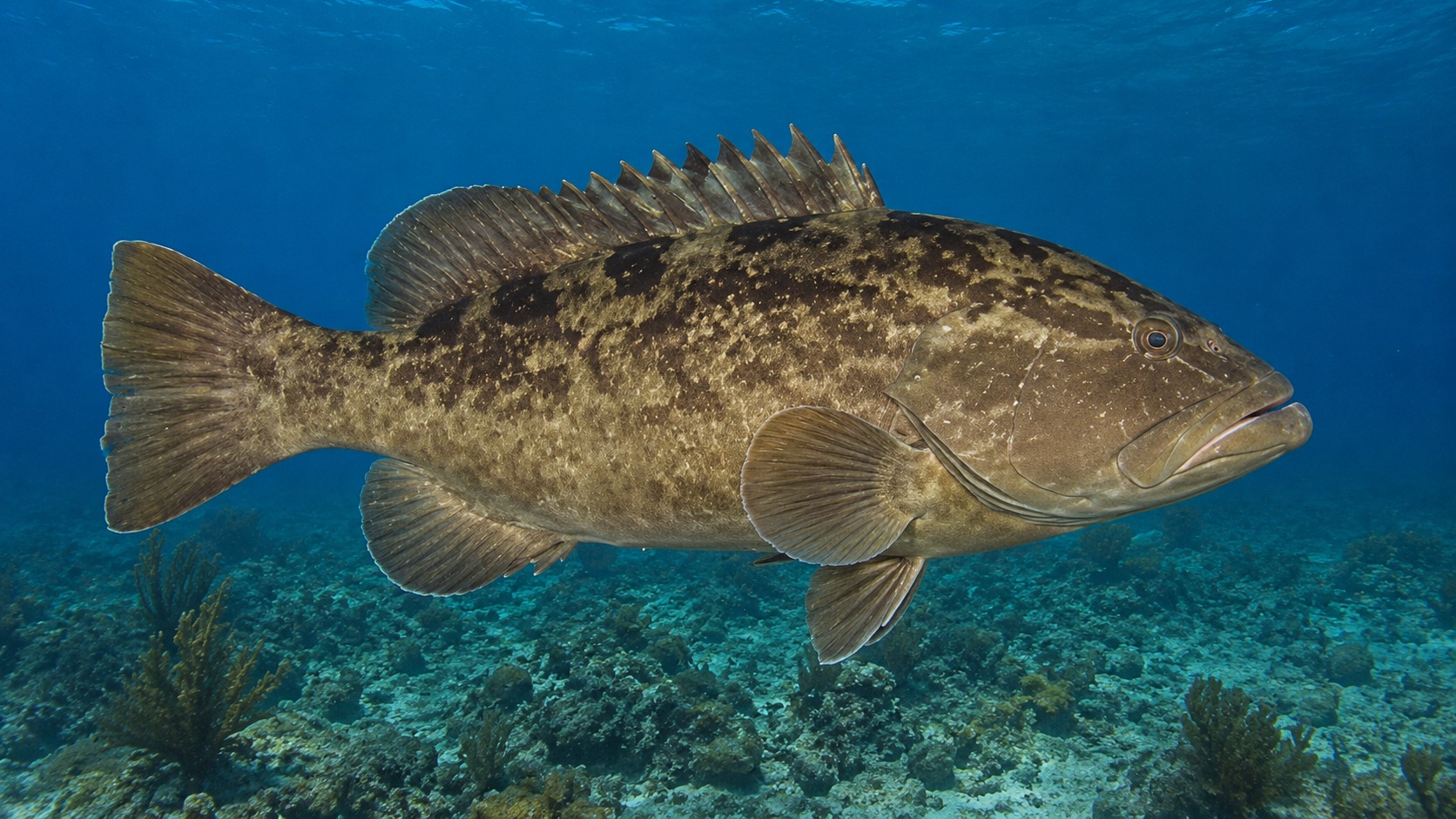
Gags are thick-bodied, broad-shouldered grouper with a slightly forked tail and a large mouth built for swallowing prey whole. Adults are dark brownish-gray on top, fading to a paler belly, with faint wavy or marbled markings along the sides. Juveniles and smaller fish show more distinct dark, kiss-shaped blotches arranged in rows. The coloration can shift dramatically depending on depth, mood, and spawning condition: a spawning male taken from deep water may look nearly black.
The most common lookalike is the scamp grouper (Mycteroperca phenax), which shares similar coloring but has distinctly extended upper-lobe rays on the tail that give it a more ragged appearance. Black grouper (Mycteroperca bonaci) runs larger and shows more rectangular blotching along the sides. In hand, check the tail: gag has a slightly concave or squared-off rear edge, while scamp shows those telltale extended filaments. All three are excellent table fish, but regulations differ, so a correct ID matters.
Where to find them
Gag grouper range along the western Atlantic from North Carolina to the Yucatan Peninsula, with major fisheries distributed across the Gulf of Mexico and the South Atlantic coast. Adults favor hard-bottom structure: limestone ledges, natural reefs, artificial reefs, rock piles, and shipwrecks in depths from roughly 40 to 250 feet. The sweet spot for most recreational anglers runs between 60 and 120 feet, where nearshore structure transitions to offshore reefs along the continental shelf.
Along the northern Gulf Coast — from the reefs off Alabama and Mississippi to the ledge systems off the Louisiana and Texas coast — gag congregate on the same type of high-relief hard bottom that draws red snapper and other reef fish. The reef systems and artificial reefs off Alabama and the Florida Panhandle (including the areas off Destin, Panama City, and Pensacola) are among the most consistently productive destinations in the Gulf. Offshore platforms and natural reefs off Louisiana and Texas hold fish as well, though the fishery thins out at the western end of the range.
On the Atlantic side, gag are present from North Carolina south through Georgia and the Florida east coast, with the fishery concentrated around nearshore and offshore live-bottom reef systems. South Atlantic fish are managed under a separate, more restrictive federal framework than Gulf fish. Juveniles recruit through estuarine seagrass and mangrove habitat before migrating offshore as they grow.
When to go
Timing a gag trip is less about picking a month off a calendar and more about understanding the water temperatures in your area — and, increasingly, keeping a close eye on the regulatory season.
Gag feed most aggressively when water temperatures drop into the 62 to 72 degree Fahrenheit range. That transition happens earlier in the year at the northern end of the range (North Carolina, northern Gulf Coast states) and later, or more briefly, along the southern Gulf. In practical terms, fall is prime across most of the fishery: as surface water cools and baitfish movements shift, gag pile onto structure and feed heavily before spawning aggregations form offshore in winter.
Spawning aggregations form in deeper offshore water from roughly January through April, but harvest is closed during most of this period. Time of day matters less than structure quality and bait presentation, though first light and late afternoon often produce faster action. Moderate tidal movement pushes baitfish past structure and triggers strikes; slack current is easier to fish but often slower.
What to throw
Live pinfish are the gold standard for gag. Hook a 4 to 6-inch pinfish through the back just ahead of the dorsal fin, drop it to the bottom on a fish-finder rig (8-ounce egg sinker above a strong barrel swivel, 5 feet of 80-pound fluorocarbon leader to an 8/0 circle hook), and give the fish just enough slack to swim naturally. The strike will be unmistakable.
Live sardines and threadfin herring work well when pinfish are scarce, especially in shallower water where gag are actively cruising structure. Live squirrelfish, grunts, and small blue runners are also productive when you can keep them lively at depth.
Bucktail jigs in the 1.5 to 3-ounce range are surprisingly effective in water under 80 feet. White, pink, and chartreuse produce consistently. Work them with short hops off the bottom, pausing to let the jig settle. The strike often comes on the drop. Tip the hook with a strip of cut squid or a fresh shrimp tail to add scent, which helps in low-visibility conditions.
Soft-plastic swimbaits in the 4 to 6-inch range rigged on a heavy jig head (1 to 3 ounces depending on depth and current) produce well. Paddle-tail profiles in white, motor oil, or chartreuse are consistent. The key is keeping the presentation near the bottom without snagging, which means reading the current and adjusting weight accordingly.
For conventional tackle, a heavy-action rod rated for 40 to 80-pound class with a quality lever-drag reel spooled with 65-pound braid and an 80-pound fluorocarbon top shot is the working standard. Gag hit heavy structure immediately after eating; the first two seconds after the strike determine whether you land the fish or lose it in the rocks. There is no such thing as too much rod.
Regulations
Gag grouper are managed federally by NOAA Fisheries under the Gulf of Mexico Fishery Management Council (Gulf stock) and the South Atlantic Fishery Management Council (Atlantic stock). Individual states — including Alabama, Mississippi, Louisiana, Texas, Florida, Georgia, and the Carolinas — set their own rules for state waters, which typically extend 3 to 9 nautical miles offshore depending on the state.
Gulf of Mexico federal waters (beyond 9 nautical miles): Seasons, bag limits, and minimum size limits are set annually by NOAA based on stock assessments. The Gulf gag stock has been classified as overfished in recent years, resulting in short, tightly constrained seasons. As of 2026, the federal Gulf season runs in September only, with a 2-fish daily bag limit and a 24-inch minimum total length, but these figures are subject to change each year.
South Atlantic federal waters: The Atlantic gag stock is managed separately and under even more restrictive rules. Check NOAA Fisheries for current South Atlantic grouper regulations before any trip.
State waters: Each state sets its own rules for the waters under its jurisdiction. Size limits, bag limits, and seasons in state waters may differ from the federal framework. Always check with your state’s fish and wildlife agency for the rules that apply to where you are fishing.
The bottom line: Gag grouper regulations change frequently in response to annual stock assessments and quota tracking. Before any trip, verify current rules at fisheries.noaa.gov/species/gag-grouper and through your state agency. In-season closures can happen quickly when quotas fill.
Handling and release
Gag grouper brought up from depths greater than 50 feet frequently suffer barotrauma: the swim bladder expands and the fish cannot descend on its own even if released immediately. If you are catching and releasing (whether voluntarily or due to undersized fish), use a venting tool or a weighted descending device to return the fish to depth quickly. A fish floating sideways at the surface will not survive.
For fish you are keeping, a sharp blow to the head and immediate placement in an ice slurry preserves meat quality. Gag flesh is white, firm, and mild, and ranks among the finest-eating fish in the Gulf and South Atlantic. It holds up well to grilling, broiling, and frying. Bleed the fish at the gills immediately after dispatch if you want the cleanest result. At legal size and in prime fall condition, a legal gag will produce two thick fillets worth every bit of the effort it took to stop that first run.
On the Table
Gag grouper is one of the most prized table fish along the Gulf Coast and South Atlantic, and anglers actively target them for the cooler as much as for the fight. Clean, mild, and versatile, gag earns its reputation as a benchmark grouper species in the kitchen.
Taste and texture: Gag grouper has bright white flesh with a mild, slightly sweet flavor that is never fishy or gamey. The texture is firm and large-flaked, holding together well under heat. It lacks the softness of some snapper species, which makes it exceptionally forgiving across a wide range of cooking methods. The flavor is clean enough for delicate preparations but sturdy enough to stand up to bold seasoning.
Best preparation methods:
- Blackening: The firm, thick fillets are ideal for blackening in a cast iron skillet. The dense texture stays intact under high heat and the mild flavor pairs well with Cajun-spiced butter without being overwhelmed.
- Grilling: Large gag fillets hold up on the grill without falling apart. A light brush of oil, salt, and citrus lets the natural sweetness come through. Score the skin side if leaving it on to prevent curling.
- Pan-frying or sauteing: Thinner portions or cheek meat respond beautifully to a simple pan-fry in butter with garlic and herbs. The white flesh takes on a golden crust while staying moist inside.
- Ceviche or raw preparations: Very fresh gag can be used in ceviche. The firm texture holds its shape through the acid cure and the clean flavor is well-suited to citrus and herb-forward profiles.
Handling for table quality: Bleed gag immediately at the boat by cutting the gill arches, then get fish on ice quickly. Grouper held in a live well or left unbled can develop a stronger flavor and softer texture. Fillet promptly once you reach the dock, removing the bloodline along the lateral line for the cleanest flavor. Thick fillets benefit from being scored or butterflied if cooking whole portions to ensure even heat penetration.
Eating caveats:
- Ciguatera risk: Gag grouper, like other large reef fish, carries a moderate ciguatera risk, particularly fish caught from reef systems in South Florida, the Florida Keys, and the Caribbean. Larger, older fish accumulate more ciguatoxin. While the risk is lower than with great barracuda or amberjack, it is worth noting for fish over roughly 20 pounds from known ciguatera-endemic areas.
- Bag and size limits: Gag grouper are subject to seasonal closures, minimum size limits, and bag limits that vary by region and year. Check current state and federal regulations before keeping fish, as rules change frequently in response to stock assessments.