A note about links: If we include links to retail sites like Amazon or Bass Pro Shops, it's because they're relevant to the topic and, as anglers ourselves, we believe they're worth checking out. As an Amazon Associate we earn from qualifying purchases.
What is it?
Striped Mullet is one of the most ecologically significant forage fish along the entire US Atlantic and Gulf coasts, from North Carolina around the Florida peninsula and west to Texas. Found in salt, brackish, and fresh water — from tidal estuaries to open beaches to freshwater rivers well inland — this hard-bodied, athletic fish is the cornerstone of the inshore food chain across a vast range. When mullet move, everything that eats fish moves with them. Snook, tarpon, redfish, cobia, sharks, bluefish, jacks, and striped bass all key in on mullet, and so do osprey, dolphins, and herons. Understanding this fish — where it lives, how it behaves, and how to put it on a hook — is one of the highest-value skills any inshore angler can develop, regardless of which coast they call home.
Striped Mullet are not just bait. They are a legitimate food fish with deep cultural roots in Gulf Coast and Atlantic coastal communities. Mullet festivals, smoked mullet traditions, and commercial fisheries follow the species across its range. That dual identity — premier bait and respected table fish — makes it worth knowing well.
How to identify one
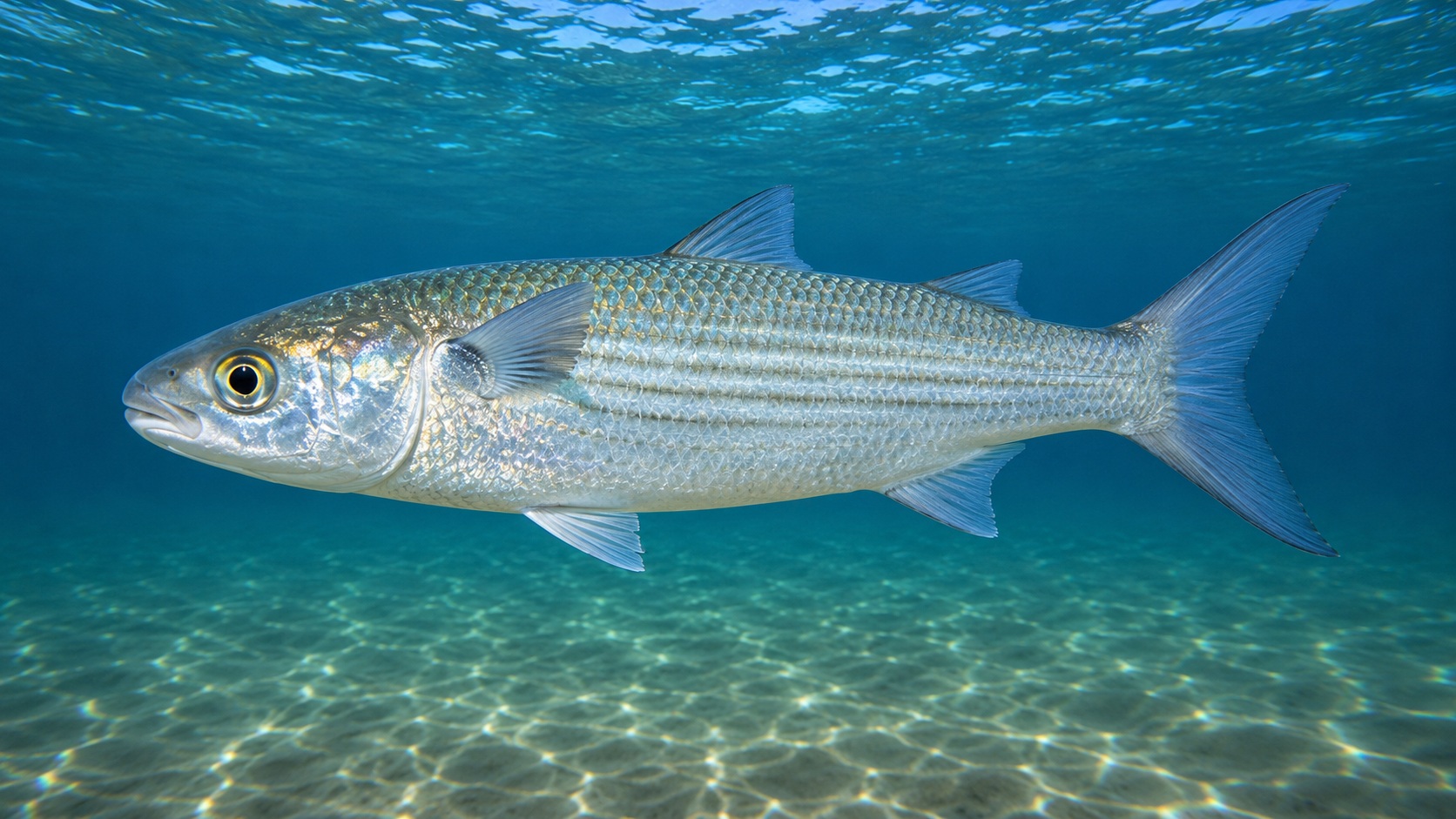
Striped Mullet are a thick-bodied, torpedo-shaped fish with a blunt, rounded snout and a small mouth set low on the face. The body is silvery-gray to olive on the back and bright silver on the sides, with 6-7 dark horizontal stripes running the length of the body along the scale rows. These stripes are the most reliable field mark and give the fish its most common name.
The head is notably flat on top — hence “flathead mullet” — and the eye is partially covered by a well-developed adipose eyelid, a fleshy transparent membrane that gives the eye a slightly glazed appearance. The tail is forked, and the fish has two separate dorsal fins: a forward fin with four stiff spines and a rear soft-rayed fin set back near the tail.
Adult Striped Mullet typically run 12 to 18 inches and 1 to 3 pounds. Fish pushing 24 inches and 4 to 5 pounds are not rare in good habitat, and individuals up to 30 inches have been recorded. For bait purposes, “finger mullet” refers to juveniles in the 3 to 6 inch range, while “large mullet” used as cut bait or live bait for big tarpon or sharks are typically 10 to 16 inches. For how to rig and fish them as bait — live finger mullet and cut chunks — see our mullet bait guide.
The species most likely to be confused with Striped Mullet is White Mullet (Mugil curema). White Mullet are smaller, usually topping out around 14 inches, and lack the strongly defined dark horizontal stripes. White Mullet also have a yellowish or brassy tinge to the base of the pectoral fins. If the stripes are bold and the fish is larger than 14 inches, it is almost certainly a Striped Mullet.
How to catch your own
Striped Mullet do not eat conventional bait — they feed on algae, detritus, and organic matter filtered from mud and sand. They will not hit a hook baited with shrimp or cut fish. That means the only reliable way to collect them is with a cast net, and learning to throw a cast net well is the single most important skill for an angler who wants a steady supply of live mullet.
Finding the fish: Mullet are school fish and they broadcast their location constantly. Look for three things: surface jumping, nervous water, and birds. Mullet jump for reasons scientists still debate, but the behavior is reliable and visible from a long distance. A school of mullet rolling or jumping near the surface in a bay, along a beach, or at a river mouth is exactly what you are looking for. Nervous water — a rippling, dimpled patch on otherwise calm water — often indicates a large school moving just below the surface. Pelicans and herons working a flat are also good indicators.
Cast net: Use a 10 to 12 foot radius cast net with a 3/8 to 1/2 inch mesh for mullet. Larger mesh lets smaller fish escape and catches bigger specimens cleanly. Approach schools quietly — mullet are easily spooked, especially in shallow, clear water. Cut the engine well short of the school and drift or pole in. Make your throw count; a spooked school can scatter and disappear in seconds. Early morning is the most productive time, as mullet are most active near the surface before the sun gets high. Tidal movement concentrates mullet at creek mouths, channel edges, and the shallower end of flats as water drains off.
Where to find them: Mullet inhabit virtually every type of inshore habitat from the Carolinas to Texas. In the warmest months, look for them on shallow grass flats and along vegetated shorelines. In cooler months they school more tightly and move into deeper creek mouths, channels, and off beaches. The fall mullet run — when massive schools move along Atlantic and Gulf beaches heading south — is the signature event of the mullet year. Along the Southeast Atlantic coast from the Carolinas to South Florida, vast schools stack up along barrier island beaches and inlet mouths during the run, providing extraordinary cast-netting opportunities. The same phenomenon plays out along Gulf Coast beaches in Alabama, Mississippi, Louisiana, and Texas. Tidal creek mouths at dawn, especially on an outgoing tide, produce mullet consistently throughout the warmer months across the entire range.
Sabiki rigs: Mullet do not respond to sabiki rigs. Their mouth structure and feeding habits make them essentially impossible to catch on a hook. The cast net is the tool.
Keeping them alive
Mullet are hardier in a livewell than many baitfish, but they still require proper care. A few guidelines:
Oxygenation: Mullet are active fish with high oxygen demand. A recirculating livewell with an aerator is the standard setup. If you are using a bucket with a battery-powered aerator and airstone, limit yourself to two to three dozen small finger mullet. Overcrowding is the fastest way to crash your bait. The fish consume oxygen faster than it can be replenished, and the entire well can turn over in minutes on a hot day.
Water temperature: Keep livewell water as cool as possible. In warm weather, livewell water can climb quickly. Adding ice in a sealed bag — not loose ice that dilutes the salinity — helps on long trips. Shaded livewells perform better than those in direct sun.
Water changes: On long trips, refreshing livewell water periodically helps purge ammonia buildup from fish waste. Even a partial water change every few hours makes a difference.
Signs of stress: Mullet rolling at the surface, swimming upside down, or clustered at the drain are all signs of oxygen depletion or overheating. Act immediately — pull some fish out, add fresh water, check the aerator.
Survival time: In a properly managed livewell, finger mullet can survive a full fishing day of 8 to 10 hours without difficulty. Larger mullet (10 inches and up) are more sensitive and may last only 4 to 6 hours. Handle them as little as possible when moving them from net to well to hook.
Cut bait value: Dead mullet are not wasted. Cut mullet is a top-tier bait for redfish, sharks, cobia, and catfish. A fresh-dead mullet cut into chunks or butterfly-cut is often more effective than inferior live bait. Mullet also freeze well; seal them whole in vacuum bags and freeze flat for future trips.
How to rig it
Mullet’s versatility as a bait comes partly from the fact that it can be rigged in multiple ways depending on the target species and presentation needed.
Nose/lip hook: Thread the hook point through both lips just ahead of the nostrils, from the bottom lip upward. This is the standard live-bait rig for free-lining or fishing under a float. The fish swims naturally, and the hook is in a clean position for a solid strike. Use this when the mullet will swim on its own without additional weight. Recommended hook: 4/0 to 6/0 circle hook for most inshore applications.
Upper jaw/palate hook: Push the hook up through the roof of the mouth into the upper jaw. This is a stronger hold than a lip hook alone and works well when casting to specific targets, reducing the chance of losing the bait mid-cast.
Dorsal/back hook: Insert the hook just forward of the dorsal fin, going through the muscle above the spine but not through the spine itself. This presentation is excellent for free-lining in current, as the mullet will struggle and dart in ways that attract predators. It is also preferred when drifting or slow-trolling larger mullet for cobia and sharks.
Tail hook: Hook the mullet just ahead of the tail in the thick muscle of the caudal peduncle. A tail-hooked mullet swims away from the angler, covering water on its own. This works well when you want the bait to swim into structure. It is harder on the fish and reduces survival time.
Under a float/cork: Nose-hook a finger mullet and suspend it 18 to 36 inches below a popping cork. Work the cork with short, sharp pops along grass flat edges, dock pilings, and vegetated shorelines. This is a classic setup for snook and redfish.
Free-lined: No weight, no float — just the hook and a nose-hooked mullet drifting in the current. This is the most natural presentation and the one that often produces the most strikes from wary fish like snook and tarpon. Let the mullet find its own level and direction.
Cut bait - chunks: Cut a dead mullet crosswise into 2 to 3 inch sections. Fish chunks on the bottom for redfish, sharks, and cobia. The cut end releases scent, which is the primary attractant.
Cut bait - butterfly/split: Remove the head, split the fish down the backbone, and open it flat. This exposes maximum flesh and is popular for sharks and large cobia. The tail section can be left on for a natural look.
Cut bait - strips: Cut thin fillets and trim into 3 to 5 inch strips. Strip bait is excellent for drifting or slow-trolling for cobia, kingfish, and bluefish. The action of a mullet strip in moving water is naturally enticing.
Hook size: For finger mullet (3 to 6 inches), use 2/0 to 4/0 circle hooks. For medium mullet (8 to 12 inches), use 5/0 to 7/0. For very large mullet used for big tarpon or sharks, 8/0 to 10/0 circle hooks are appropriate.
What it catches
Striped Mullet is effective for an exceptionally wide range of predator species. Here is how to use it for the main targets:
- Snook - Live finger mullet free-lined into mangrove shorelines, dock shadows, or along beach structure during the fall mullet run. Nose-hook and let it swim naturally. This is snook fishing at its most exciting and most productive.
- Tarpon - Large live mullet (10 to 14 inches) nose-hooked and free-lined in passes, inlets, and along beaches during the mullet run. Cut mullet chunks fished on the bottom in passes and channels also produce tarpon. The fall mullet run along the Southeast Atlantic coast is the premier tarpon event of the year.
- Redfish - Live finger mullet suspended under a popping cork over grass flats and along oyster bars, or cut chunks fished on the bottom in channels and creek mouths. Redfish are opportunistic and will take both live and dead mullet readily across the Gulf Coast and Southeast Atlantic states.
- Cobia - Large live mullet or butterfly-cut chunks fished near crab trap buoys, channel markers, and structure. Cobia follow rays and sharks inshore and respond well to a large mullet presented near the surface.
- Sharks - Any size dead mullet, cut into chunks or used whole on a fishfinder rig, is a standard shark bait from the beach or boat across the entire range. The oily flesh releases strong scent trails.
- Bluefish and Spanish Mackerel - Strip baits cut from mullet flesh, trolled or drifted, are effective for both species along beaches and nearshore structure from the mid-Atlantic states through the Gulf Coast.
- Striped Bass - Along the mid-Atlantic and Northeast coasts, live mullet are used as a premier striper bait, especially during fall migrations when both species are on the move simultaneously.
- Jack Crevalle - Jacks will crash mullet schools aggressively. A live finger mullet cast into a feeding frenzy draws immediate strikes.
When to go
Mullet are present in coastal waters year-round across most of their range, but activity and availability peak when water temperatures are in the upper 60s to mid-70s Fahrenheit. The fall mullet run is the signature event: as water cools in autumn, massive schools begin a southward migration along Atlantic and Gulf Coast beaches. In the Southeast and Gulf states this typically occurs from September through November; farther north along the mid-Atlantic coast the run comes earlier, often in August and September. In warmer southern waters, mullet remain active and catchable even in winter.
In summer, when water temperatures are highest, mullet scatter across grass flats and estuary shallows throughout their range. Early morning and evening are the most productive times of day for cast-netting in warm weather, as schools are most active near the surface before midday heat drives them deeper.
The practical rule: when water temperatures fall into the 65 to 75 degree range in your area, start watching the beaches. The run timing shifts by several weeks between the Carolinas and the western Gulf Coast, but the same behavior — dense schools moving along the surf line — plays out predictably every fall.
Regulations
Regulations for Striped Mullet vary by state and sometimes by region within a state. Always check with your state’s fish and wildlife agency before targeting mullet for bait or the table. Rules may address net types and dimensions, daily bag limits, minimum size limits, and seasonal closures. Several Gulf Coast and Atlantic states actively manage their mullet fisheries given the commercial importance of the species.
At the federal level, NOAA’s FishWatch program provides an overview of Striped Mullet’s stock status and management considerations. For the most current recreational rules, go directly to your state agency — rules can and do change between seasons.
On the Table
Striped Mullet is genuinely good eating, though it requires understanding what you are working with. The flesh is rich and oily — more so than most inshore fish — and that oil content is the key to both its flavor and its reputation. Fresh mullet with a mild flavor has a firm, moderately flaky texture. Fish that are not bled and iced immediately can develop a strong, “muddy” taste that has given mullet an undeserved bad reputation in some circles.
Smoking is the preparation that made mullet famous along the Gulf Coast, from the Florida Panhandle and Nature Coast through Alabama, Mississippi, and Louisiana. Butterflied and slow-smoked over oak or citrus wood, mullet develops a deep, complex flavor that rivals any smoked fish. Smoked mullet dip — blended with cream cheese, hot sauce, and fresh herbs — is a staple at fish camps and coastal restaurants across the Gulf region. Mullet festivals in Gulf Coast communities draw thousands of attendees each fall specifically to celebrate the fish.
Fried mullet is the other classic preparation: fillets dipped in cornmeal and fried hot. The key is absolute freshness. Mullet caught, bled, and iced immediately — then cooked the same day or the next — is a completely different experience from mullet that has sat ungutted in a cooler for a day.
The roe from female mullet, particularly the dried and pressed roe known as bottarga, is considered a delicacy and commands high prices in specialty markets. Mullet roe season aligns with the fall run.
If you catch mullet and do not want to eat them, freeze them whole in sealed bags for future cut bait. Very little goes to waste with this fish.