A note about links: If we include links to retail sites like Amazon or Bass Pro Shops, it's because they're relevant to the topic and, as anglers ourselves, we believe they're worth checking out. As an Amazon Associate we earn from qualifying purchases.
What is it?
The golden shiner (Notemigonus crysoleucas) is one of the most ecologically important and commercially significant baitfish in North America. Native across the eastern United States and southern Canada, this small cyprinid occupies the middle of the freshwater food chain — it eats microscopic plankton, algae, and tiny invertebrates, and in turn gets eaten by nearly every predatory fish worth chasing. Largemouth bass, northern pike, muskellunge, walleye, striped bass, and large crappie all target golden shiners as a primary forage item.
For anglers, that position in the food chain is the whole point. A large, lively golden shiner swimming under a float in a weed bed is arguably the most effective single presentation for trophy largemouth bass in the country. Big-bass fisheries across the South — from Florida’s storied reservoirs to the shallow impoundments of Texas and Georgia — have built entire guide industries around wild-caught and commercially farmed golden shiners. The gold lateral sheen and side-to-side swimming action trigger a predatory response in large bass that artificial lures simply cannot replicate with the same consistency. The same quality makes shiners a go-to choice for northern pike and muskellunge anglers across the Great Lakes region, New England, and Canada.
Beyond the trophy fishery, golden shiners matter because understanding them changes how you read water. When you see a school of shiners nervous at the surface, spraying out of the water in a tight ball, or being pushed by birds working from above, you are watching the live-action version of what bass anglers call “breaking fish.” Finding the bait always finds the predators.
Golden shiners are farmed commercially on a large scale, particularly in Arkansas, and are sold at bait shops across the country. Wild-caught specimens — especially those netted from the same body of water you are fishing — are considered superior to farm-raised fish because they are already acclimated to local conditions and carry no off-putting odors from pond culture. For how to rig and fish them — under a float, free-lined, or on a jig — see our minnows & shiners bait guide.
How to identify one
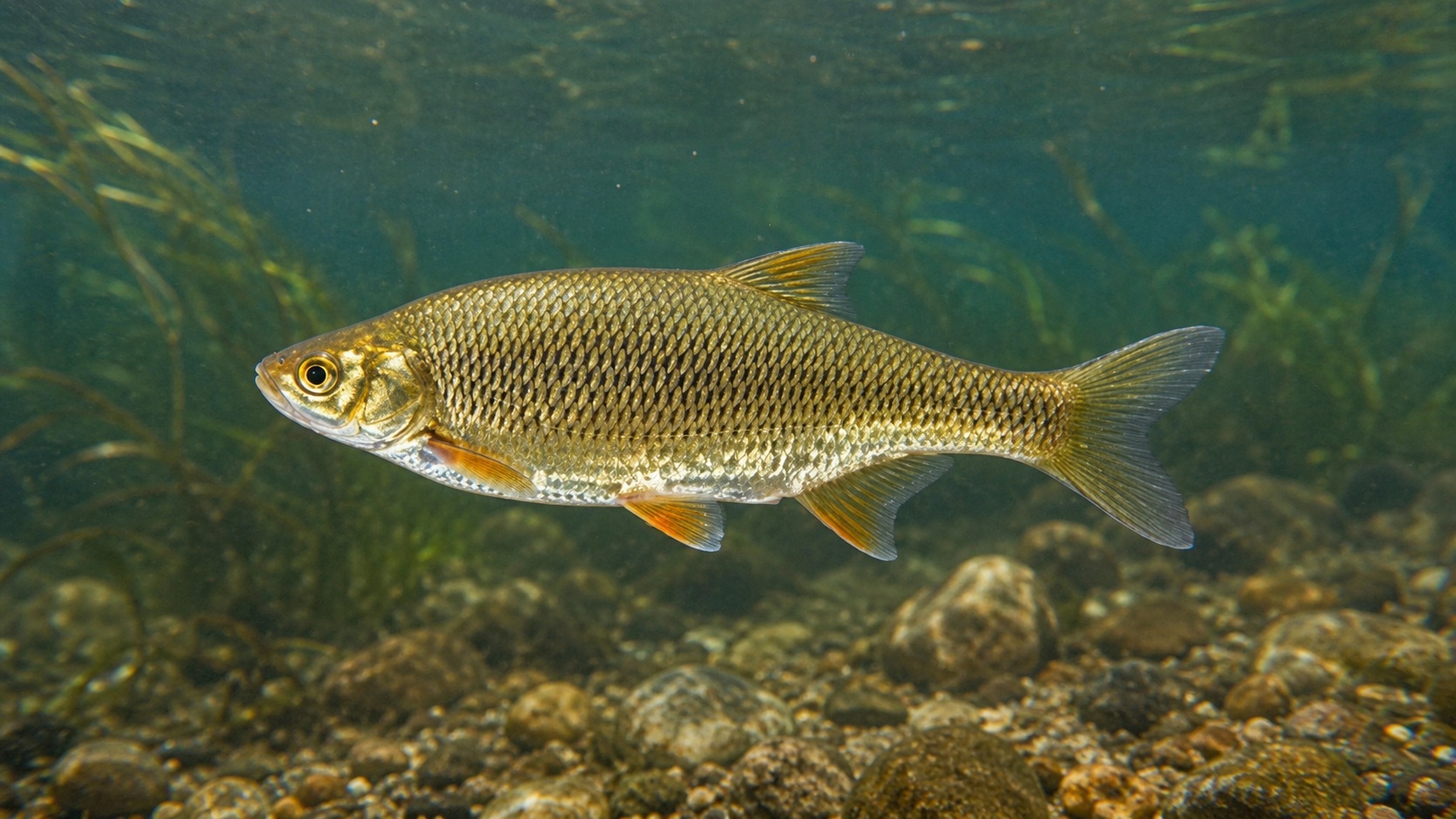
Golden shiners have a distinctive body shape that sets them apart from most other small fish you might encounter: they are noticeably deep-bodied and laterally compressed, almost like a miniature sunfish in profile, with a distinctly arched back and a keel-like ridge along the belly between the pelvic and anal fins. That keel is a reliable field mark and unique among common baitfish species in their range.
Color and sheen: Juveniles and fish from turbid water tend toward a silvery appearance, but adults in clear water develop the golden-bronze flanks that give the species its name. In direct sunlight, the sides flash a warm gold to brassy yellow. The back is olive to greenish-brown. The fins are often tinged pale yellow or cream. There is no distinct lateral stripe, which helps distinguish golden shiners from species like the emerald shiner or various dace that carry bold horizontal markings.
Size: Most golden shiners you encounter in natural water range from 2 to 5 inches. Fish in the 3 to 4-inch class are the most common bycatch size. A “big” wild golden shiner goes 5 to 6 inches; 7-inch fish exist but are uncommon in most waters. Commercially farmed “jumbo” shiners sold specifically for trophy bass fishing are typically graded at 4 to 6 inches, with some sellers offering 6 to 8-inch fish at premium prices.
Mouth and scale detail: The mouth is small, slightly upturned, and toothless — no jaw teeth, which is typical of the minnow family. The scales are large and loosely attached, meaning the fish loses scales easily when handled. A lateral line runs the full length of the body.
Similar species: The most common confusion is with the emerald shiner (Notropis atherinoides), which is more streamlined and torpedo-shaped rather than deep-bodied, with a greenish dorsal surface and a faint emerald iridescence on the flanks rather than gold. Juvenile carp can superficially resemble golden shiners at small sizes, but carp have two small barbels at the corners of the mouth; golden shiners have none. Fathead minnows (Pimephales promelas) are stubbier, more cylindrical, and lack the deep body profile. Once you have seen a golden shiner’s deep, laterally compressed body next to a round-bodied fathead, the distinction is obvious.
How to catch your own
Catching your own golden shiners is entirely practical, and in many situations wild-caught fish will outperform store-bought bait. The two most effective methods are cast nets and minnow traps, with dip nets useful in specific shallow situations.
Cast net: This is the most efficient method when you can locate a school. Use a 4 to 6-foot radius cast net with 1/4-inch mesh — small enough to retain 2-inch fish but easy to throw and retrieve. Monofilament nets in the 3/8-inch mesh range work if you are only targeting larger fish above 3 inches. Note that cast net regulations vary by state; some states prohibit or restrict their use on certain waters, so check local rules before throwing.
Golden shiners are most catchable in the early morning and late afternoon when they move to the shallower edges of ponds, coves, and lake margins to feed. Look for nervous surface activity: a school feeding on surface film will produce subtle dimples and small rings, distinct from the larger splashes of feeding predators. In vegetation-heavy water, shiners often hold just along the outer edge of weed lines, lily pad fields, or shoreline grass. On clear-water lakes, polarized glasses will let you spot schools in 2 to 4 feet of water before you throw.
When you find a school, toss a small handful of fish food pellets, bread crumbs, or cracker crumbs to hold them in place before your cast. This “chumming” is not always necessary but significantly improves success on spooked or scattered fish. Lead the school slightly — throw just ahead of where they are moving rather than directly into them.
Minnow traps: Wire mesh minnow traps baited with bread, crackers, or commercial minnow bait and set in 2 to 4 feet of water along vegetated shorelines will catch golden shiners with almost no effort. Leave traps overnight and check in the morning. Traps work best in ponds, small coves, and quiet backwaters with little current. They are less efficient per unit time than cast nets when fish are schooling visibly, but they require no active presence and can fill a bucket while you sleep.
Dip nets: A 2 to 3-foot diameter dip net is useful in specific situations — shallow, heavily vegetated areas where shiners are concentrated and hard to reach with a cast net. Move slowly along the bank and position the dip net ahead of the fish before they scatter.
Reading baitfish behavior: When you arrive at a lake and want to find where shiners are concentrated, watch the water surface before you do anything else. A school of shiners being herded by bass will scatter explosively in multiple directions at once, creating a flat-water “explosion” of tiny fish. Wading birds — herons, egrets, and kingfishers — perched along a shoreline or working a specific area are marking baitfish location. Diving birds working a mid-lake area offshore are often targeting shiner schools from above while bass work from below.
Seasonal notes: Golden shiners are easiest to catch when water temperatures are in the 60 to 72-degree range and fish are actively feeding near the surface. In southern states this window arrives in late winter and extends through spring; farther north it falls in spring and early summer. They become harder to locate when temperatures push into the upper 70s and above, as fish push deeper and school tighter. A second productive window opens in fall as temperatures drop and fish fatten up before winter.
Keeping them alive
Live bait quality is the difference between fishing and catching when using golden shiners, and they are one of the more demanding baitfish to keep alive. Compared to fathead minnows, golden shiners are oxygen-sensitive, stress-prone, and quick to die in suboptimal conditions. The effort is worthwhile given how effective they are, but you have to take it seriously.
Aeration and oxygen: Golden shiners require continuous, vigorous aeration. A basic battery-powered aerator is the minimum — the style that clips to a bucket or cooler and pumps air through a diffuser stone. For larger quantities in a live well, a recirculating aerated live well is significantly better. Shiners will begin to stress and surface within minutes in an unaerated container, especially in warm water. If you are fishing in a boat with a built-in live well, run the aeration continuously, not on the cycling timer setting.
Water temperature: This is the biggest killer. Golden shiners die quickly in water above 75 to 78 degrees Fahrenheit. In warm-weather fishing across the South and Midwest, managing live well temperature is critical. Serious trophy bass guides carry a block of ice specifically for the live well. The fish you buy at the bait shop were likely kept in a tank around 65 to 68 degrees. If your live well is 80 degrees when you add them, expect rapid mortality. Add ice gradually to cool the well before introducing fish, and maintain temperature throughout the day. In cooler northern waters during spring and fall, this is less of a concern, but summer fishing anywhere in the species’ range can push temperatures into the danger zone.
Stocking density: Less is more. Overcrowding is one of the most common causes of dead bait before noon. A 30-quart live well should hold no more than two to three dozen shiners of 4-inch size with proper aeration. A 20-gallon tank can hold 50 to 75 fish comfortably. If fish are rolling at the surface, laying on their sides, or gasping near the aerator stone, you have too many fish for your aeration capacity.
Water changes: If you are keeping fish in a bucket without a recirculating system, change 25 to 30 percent of the water every hour to remove waste. Use water from the same body of water you are fishing to avoid temperature shock.
Signs of stress: Fish rolling at the surface and gasping for air means oxygen depletion — increase aeration and reduce density immediately. Fish hanging vertically in the water column, nose down, are in serious distress. A fish that swims sluggishly when placed on a hook is already compromised and will not attract strikes the way a lively fish will. Discard spent fish and replace with fresh ones throughout the day.
Survival timeline: Well-managed golden shiners in a properly aerated, temperature-controlled live well can survive an 8-hour fishing day with reasonable losses. Expect 10 to 20 percent attrition under good conditions, 50 percent or more if temperatures exceed 78 degrees or aeration is inadequate.
If they die: Dead shiners have value as cut bait for catfish and can be frozen for later use. A fresh-dead golden shiner on a catfish rig is a good secondary use for fish that did not survive the trip. Freeze dead bait in zip-lock bags in water to preserve quality.
How to rig it
Golden shiners are most effective when kept alive and given the freedom to swim naturally. The single most important rigging principle is using a hook small enough to minimize injury to the fish while still being large enough to reliably hook your target.
Nose or lip hook: Pass the hook point through both lips from bottom to top, or through the upper lip only. This is the most common and generally most effective hook placement because it leaves the fish able to swim freely. It causes the least internal damage and keeps the fish alive longest. Use a size 1 to 2/0 circle hook or light-wire live bait hook depending on the size of the fish. For trophy bass, a 3/0 to 5/0 circle hook works well with 5 to 6-inch shiners.
Dorsal hook: Pass the hook point just under the dorsal fin, entering just ahead of the fin and angling the hook toward the head. This placement is used when free-lining in heavy cover or when you want maximum swimming action. It allows the fish to swim more powerfully than a nose hook and is the preferred method when fishing without a float. The fish stays lively longer because you avoid the nasal passages.
Tail hook: Hooking just in front of the tail fin works when you want the shiner to struggle and kick in place rather than swim away — useful in tight cover situations where you want the fish to stay in a specific zone. This placement is less common but effective when fishing directly under a dock or in a pocket in the vegetation.
Under a cork or float: A classic trophy bass presentation is a large cork float — typically 1 to 2 inches in diameter — set at a depth of 2 to 6 feet depending on conditions, with a nose-hooked or dorsal-hooked shiner running below it. The float keeps the bait in the strike zone over hydrilla, eelgrass, or lily pad edges, and provides visible strike detection. A large bass hitting a float typically produces a violent dive and run rather than a subtle movement. When the float goes down, hesitate one to two seconds before setting the hook to allow the fish to turn the bait. This same presentation works over weed beds in Great Lakes states targeting pike and muskellunge — scale the float and hook size up accordingly.
Free-line: No weight, no float — just hook the fish through the dorsal area and let it swim freely with minimal tension on the line. This is the highest-percentage presentation in open water or over scattered grass when bass are actively feeding. The shiner will swim away from pressure and down into the strike zone on its own. Use a sensitive spinning rod so you can feel the subtle changes in the baitfish’s behavior when a bass approaches.
Carolina rig: A sliding egg sinker above a swivel with a 12 to 24-inch fluorocarbon leader to the hook. This is used to keep the shiner near the bottom in deeper water, around channel edges, dock pilings, or over submerged structure. A 1/2 to 1-ounce sinker is typical. The nose-hook placement works best here.
Cut bait: Cut a dead golden shiner into chunks 1 to 1.5 inches thick for catfish rigs. The head section, with its strong scent glands, is often the most productive piece. A butterfly cut — splitting the body lengthwise but leaving it connected at the head — provides maximum surface area for scent dispersal in current.
Hook size summary: For panfish or crappie using smaller shiners (2 to 3 inches), a size 6 to 4 wire hook. For bass with medium shiners (3 to 4 inches), size 1 to 1/0. For trophy bass with large shiners (4 to 6 inches), 2/0 to 5/0 depending on hook style and presentation.
What it catches
Golden shiners are versatile bait that will attract nearly any predatory freshwater fish, but they are specifically and deliberately used for the following target species:
Largemouth bass — the primary use: No other live bait consistently produces trophy largemouth at the same rate as a large, lively golden shiner. Across the South — from Florida’s shallow reservoirs to the big impoundments of Texas, Georgia, and the Carolinas — live shiner guide trips are built around this presentation. Fish a 4 to 6-inch shiner on a float over weed beds, around submerged timber, or along the edge of lily pad fields. The golden flash and erratic swimming action of a spooked shiner triggers the largest fish in an area. Morning and evening feeding windows are most productive.
Northern pike: Large golden shiners, 5 to 7 inches, are excellent pike bait across the upper Midwest, New England, and Canada. Pike attack shiners with the same aggression they show toward any flashy forage fish. A shiner suspended under a large float near weed edges or over drop-offs in pike lakes will draw fish that ignore most artificial lures. Use a short wire leader to prevent bite-offs.
Walleye: In reservoirs and natural lakes where shiners are present as natural forage, a lively shiner slow-trolled or drifted along a deep weed edge at night is a legitimate big-walleye presentation. A 3 to 4-inch shiner on a plain hook with a small split shot, or Carolina-rigged along a rock pile, mimics what walleye are already feeding on in many waters.
Crappie — black and white: In waters where golden shiners naturally occur, 1.5 to 2-inch juvenile shiners are outstanding crappie bait, fished on a small jig head or light-wire hook under a small float around dock pilings, brush piles, or submerged timber. Some crappie anglers prefer shiners to worms because they stay lively on the hook longer and attract larger fish.
Striped bass and hybrid striped bass: In southern reservoirs where striped bass and hybrids chase shad, golden shiners make an effective alternative when shad are hard to obtain. A live shiner freelined or drifted below a float along current breaks, dam faces, and riprap will draw strikes from fish that are actively surface-feeding or suspended in the water column.
Catfish: Though not the top choice, cut golden shiner produces reliably for channel catfish and flathead catfish. The flesh is soft and oily enough to release scent effectively. Flathead catfish, in particular, strongly prefer live bait, and a large shiner rigged on a heavy hook near bottom structure in a river channel is a legitimate flathead presentation.
On the Table
Golden shiners are almost never eaten intentionally, and for practical reasons. At typical baitfish sizes of 2 to 5 inches, there is essentially nothing to clean — the edible flesh-to-bone ratio is negligible, and the small bones are distributed throughout the body in the way typical of cyprinid fish. The flesh is soft and not particularly flavorful.
At 7 or 8 inches — the maximum size most anglers would ever encounter in the wild — a golden shiner is more like a large minnow than a panfish, still not worth the cleaning effort in any conventional sense.
In parts of East and Southeast Asia, small cyprinids are commonly deep-fried whole and eaten bones and all as a crispy snack, and golden shiners would technically be edible prepared the same way. There are no documented traditional culinary uses for golden shiners in North American fishing culture.
If you catch a large golden shiner incidentally and want to keep it, the honest answer is to use it as bait. It is far more valuable as live bait for bass or pike than as table fare, and releasing it — if not using it immediately — returns a productive forage fish to the ecosystem.