A note about links: If we include links to retail sites like Amazon or Bass Pro Shops, it's because they're relevant to the topic and, as anglers ourselves, we believe they're worth checking out. As an Amazon Associate we earn from qualifying purchases.
What is it?
The alewife is a small, silvery herring that leads a double life — or rather, two populations of the same species have ended up living completely different ones. Understanding which alewife you are dealing with, and where, changes everything about how you fish for them and what they mean to the fishery around you.
The anadromous Atlantic coast population is the original: a sea-run fish that spends most of its adult life in the ocean and returns every spring to the same freshwater rivers, streams, ponds, and lakes where it was born. Alewives range along the entire Atlantic coast of North America from Newfoundland to Florida, and their spawning runs — called river herring runs, a term they share with the closely related blueback herring — are one of the great recurring natural events of the northeastern spring. Spawning adults enter coastal rivers from early May through early June, pushing upstream to reach quiet ponds and lake margins where water temperatures hit the 13 to 16 degrees Celsius range. Each female produces between 60,000 and 100,000 eggs. Juveniles spend one to three months in freshwater nursery habitat before migrating seaward in late summer and fall, typically in the 32 to 152 mm size range. Most fish live four to five years and return to spawn multiple times, though repeat spawners represent perhaps only 25 percent of any given run.
The ecological role of anadromous alewives is difficult to overstate. The Maine DMR fact sheet puts it plainly: “Everything eats alewives.” Striped bass, bluefish, tuna, cod, haddock, halibut, American eel, brook trout, lake trout, landlocked salmon, smallmouth bass, largemouth bass, pickerel, pike, perch, seabirds, bald eagles, osprey, herons, seals, whales, otter, mink, and multiple other mammals all depend on alewives as a food source at some stage. Their spring migration pulses marine-derived nutrients into freshwater systems and freshwater-derived nutrients into coastal marine systems. They are a nutrient conveyor belt between ecosystems.
The landlocked Great Lakes population is an accident of history with enormous consequences for modern fishing. Alewives are not native to the Great Lakes. The first documented occurrence in Lake Ontario was 1873, and by 1960 they had spread through the entire basin after bypassing Niagara Falls via the Welland Canal. The Great Lakes at that point lacked the predators that would have kept alewife in check: lake trout had been largely eliminated by overfishing and sea lamprey predation, and the lampreys themselves were a concurrent invasion. Without predation, alewife populations exploded through Lake Michigan, Lake Huron, and Lake Ontario, exceeding the ecosystem’s carrying capacity and triggering massive die-offs. In the 1960s, dead alewives washed ashore in windrows along Great Lakes beaches by the millions, a public crisis that prompted emergency management action and permanently changed the trajectory of the Great Lakes fishery.
That management response was the introduction of Pacific salmon. Michigan began stocking coho salmon in 1966; Chinook stocking followed. The salmon thrived on the abundant alewife, their populations grew rapidly, and what had been a public nuisance became one of the greatest freshwater sport fisheries in North America. At peak, alewives comprised 50 to 80 percent of the Great Lakes pelagic fish biomass, and the entire Chinook and Coho salmon charter industry was built on that forage base.
The relationship between alewife abundance and Great Lakes fishing quality is direct and consequential. When alewife populations in Lake Huron collapsed after 2003 — driven by a combination of reduced prey (zooplankton competition was already strained) and recovering native prey fish — the salmon fishery followed. By the mid-2000s, Lake Huron had shifted from a system dominated by alewife and Chinook salmon to one where both were nearly absent, and angler effort dropped roughly 90 percent. Lake Michigan retained more alewife and maintained a stronger salmon fishery longer, but managers there work carefully to keep the alewife-salmon balance within sustainable bounds. When you book a Great Lakes salmon charter, the fishing report is, at some level, an alewife report.
How to identify one
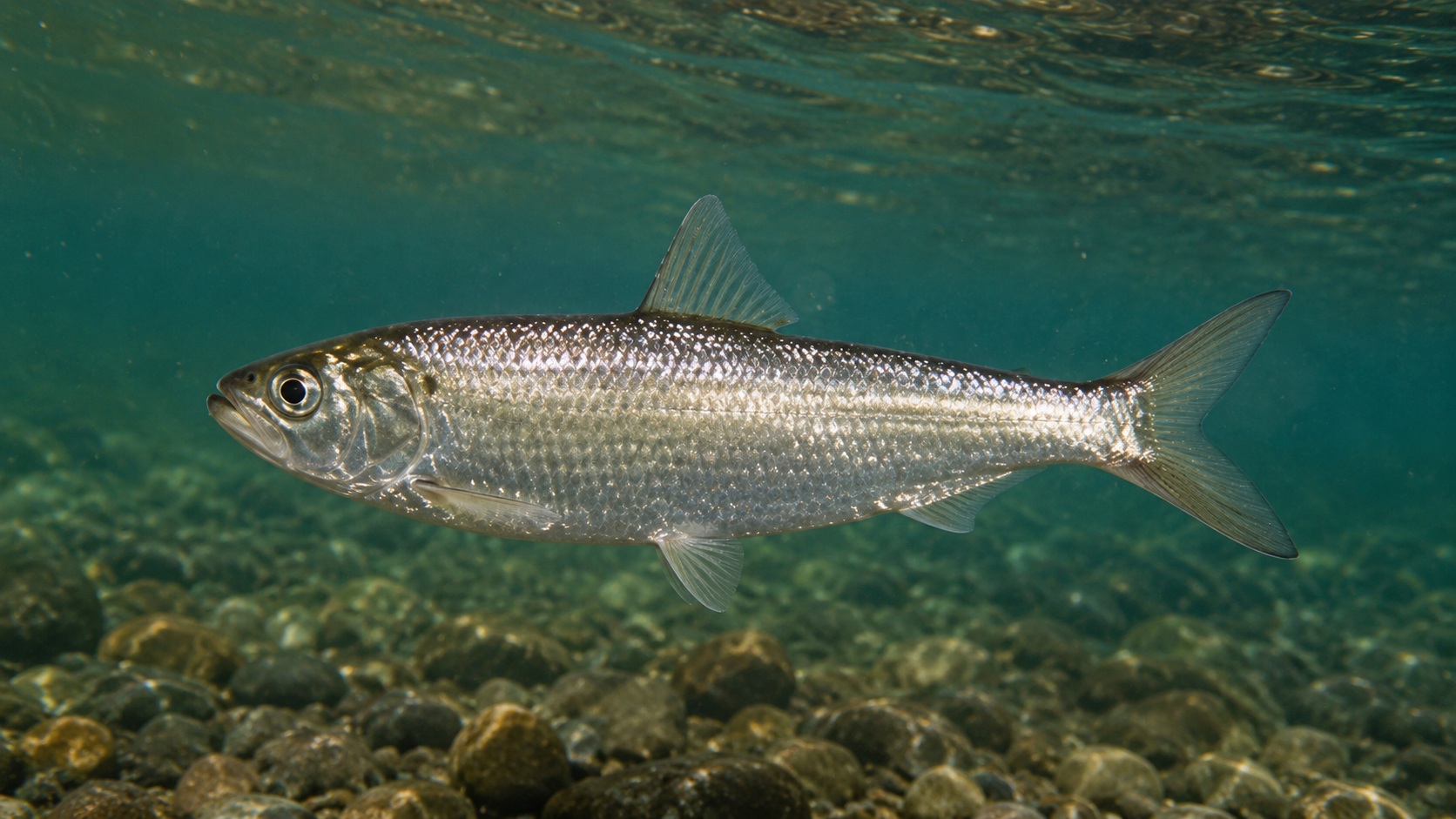
Alewife are laterally compressed, deep-bodied herrings built like a blade. In hand, the first thing you notice is how thin they are relative to their depth — they are a coin with a tail. Adult spawning fish average 279 to 305 mm (about 11 to 12 inches) in length and weigh around 230 grams (roughly half a pound). Maximum recorded size in marine environments reaches about 38 to 40 cm (up to 16 inches), though Great Lakes landlocked fish are typically smaller.
The body coloration is gray-blue to grayish-green on the dorsal surface, transitioning to bright silver-white on the sides and belly. The head has a bronze cast in good light. The back has a subtle metallic sheen that can appear greenish or bluish depending on angle.
The definitive field marks:
Large eye. This is the “bigeye herring” name in action. The eye of an alewife is disproportionately large relative to head size — a reliable and immediately visible feature. The classic rule from fishery biologists is that the width of the alewife’s eye often equals or exceeds the length of its snout. If the eye looks oversized for the head, you are probably looking at an alewife.
Dark shoulder spot. A single dull black or dark gray spot sits just behind the gill plate (operculum). This humeral spot is usually clear on fresh fish and fades after death. It is present in multiple herring-family species but is a consistent alewife mark.
Scute scales along the belly. Run a finger along the belly from the pectoral fin to the tail and you will feel a row of sharp, modified scales called scutes arranged like saw teeth. These serrated belly scales are the origin of the “sawbelly” common name. They are present in most shad-family herrings but are sharper and more prominent in alewife than in many relatives.
Lower jaw. The lower jaw projects noticeably beyond the upper jaw, a feature shared with blueback herring but useful for eliminating other species.
Light peritoneum. If you clean one, the peritoneal lining (the membrane inside the body cavity) is pale or light-colored with small spots. Blueback herring have a dark peritoneum, which is the surest internal distinction between the two species when size and eye do not clinch it.
Distinguishing alewife from similar species: Blueback herring (Alosa aestivalis) is the species most commonly confused with alewife in Atlantic coast rivers. Bluebacks have a noticeably smaller eye (snout length exceeds eye diameter), a darker back that is more purely blue rather than blue-gray, and a dark peritoneum. Bluebacks also spawn slightly later (late April through mid-June versus early May in alewife) and prefer flowing river current rather than ponds and lakes. American shad (Alosa sapidissima) and hickory shad (Alosa mediocris) are both significantly larger, typically 15 to 24 inches, and have different jaw proportions. If the fish is over 13 inches and heavy, it is almost certainly not an alewife.
How to catch your own
Alewife are not typically targeted for sport — they do not bite a hook in the usual sense. Their diet is primarily zooplankton, which means traditional hook-and-line fishing is mostly ineffective. The goal is capture, not sport, and the methods reflect that.
Atlantic coast — spring river runs: During the spawning migration, alewives concentrate in the shallows just downstream of dams, waterfalls, and fish passage structures where they stack up before ascending. These congregations can be dense enough to see from shore. The traditional and still-dominant method is a dip net — a large-frame mesh net on a long handle, lowered into the school and scooped upward. In areas where regulations permit, cast nets work well in pools below falls, especially at dusk and into darkness when fish are most active near the surface. Check state regulations carefully before using any net; many Atlantic coast states regulate or restrict river herring harvest, and some have moratoriums in place. The Massachusetts, Maine, and other New England DMR sites list current regulations by watershed.
Great Lakes — summer and early fall: Landlocked Great Lakes alewives school densely in open water near harbors, piers, marina entrances, and the transition zones between warm surface water and cooler deep water. They can be found in 5 to 60 feet of water depending on season and time of day. The two most effective capture methods are:
Sabiki rig: A Sabiki is a multi-hook dropper rig carrying 5 to 8 small hooks, each decorated with a tiny metallic lure, bead, or bit of colored material. Drop it vertically into a school of visible alewife or into the mid-water column where fish appear on a depth finder, and jig it with small rhythmic lifts. Alewife hit Sabiki hooks readily — the tiny lures mimic zooplankton well enough. Use a 20 to 40-gram sinker at the bottom to keep the rig dropping straight in current. Pull up the moment you feel multiple fish, or you will lose them. A No. 4 to No. 6 hook size on the Sabiki matches alewife mouth size.
Cast net: A cast net of 8 feet or less in diameter (check your state’s specific limit) thrown from a pier, breakwall, or boat over a visible surface school is extremely efficient when alewives are shallow. Early morning in summer harbors is classic timing — fish stack in relatively shallow, warm water near structure and are visible from above.
In both Atlantic coast and Great Lakes contexts, alewife typically school at depth during midday and come shallow in low-light conditions, so first light and dusk are the most productive harvest windows.
Keeping them alive
Alewife are fragile. They share the same physiological weaknesses as most herrings: high metabolic rate, extreme sensitivity to oxygen depletion and physical stress, and rapid descent into fatal shock when water quality degrades. Keeping alewife alive long enough to use them as live bait is genuinely difficult, and most Great Lakes anglers do not bother — fresh-dead, salted, or frozen alewife are the standard because they catch fish just as effectively as live ones and require no special livewell management.
If you want to use them live, the requirements are similar to menhaden and other herrings: continuous aeration or oxygen injection in a circular or oval livewell, cool water temperatures (below 65 degrees Fahrenheit if possible), low stocking density, and minimal handling. Descaling during net capture damages their protective mucus layer and accelerates stress mortality. Transfer fish to the livewell immediately and avoid letting them flop on hard surfaces. Expect a window of one to two hours of reliable liveness under good conditions, and plan accordingly.
For most practical purposes, catch alewives in quantity, dispatch them quickly with ice or a cooler of cold water, and rig them fresh or frozen. A well-iced fresh alewife fishes nearly as well as a live one for most target species, and frozen alewife — individually wrapped in plastic and frozen flat — keeps for months and is a standard Great Lakes trolling staple year-round.
How to rig it
Great Lakes — Chinook and Coho salmon downrigger trolling: This is the single most important use of alewife as bait in North America by sheer volume of fish caught. Rig a whole frozen or fresh alewife (8 to 10 inches) on a stainless bait needle or stinger rig, running the hook through the nose or just behind the head with a trailing stinger hook at the tail. Fish the rigged alewife on a dodger-and-fly setup: the dodger (a large metal flasher, 8 to 11 inches) is attached to the main line above the bait rig on a short 10 to 16-inch leader. The dodger provides erratic side-to-side action that attracts salmon, and the alewife behind it presents as a fleeing, injured forage fish. This combination on a downrigger trolled at 2 to 3.5 mph in the 30 to 120-foot depth range is responsible for the majority of Great Lakes Chinook and Coho salmon caught by charter and recreational anglers.
Great Lakes — lake trout and brown trout: A whole fresh or salted alewife on a 3/0 to 5/0 J-hook or circle hook, fished on the bottom or jigged slowly along rocky structure, is a proven lake trout presentation. The natural scent of fresh or lightly salted alewife is a significant attractor. For brown trout in nearshore zones, trolling a whole frozen alewife behind a smaller dodger at shallower depths (15 to 30 feet) produces well in spring and fall.
Atlantic coast — striped bass: Whole alewife, fresh or lightly salted, on a 6/0 to 8/0 circle hook through the lips or nose is a classic large striper bait in Atlantic coast rivers during the spring run. Alewife are a primary striper forage item during their river migration, and stripers follow alewife schools into tributary rivers at the same time. A whole alewife free-lined in a tidal river or drifted below a weighted line puts the bait exactly where hungry stripers are feeding.
Atlantic coast — bluefish and weakfish: Cut alewife into 2- to 3-inch chunks and hook once through the chunk with the point exposed. The oily flesh of alewife creates a scent trail that bluefish follow readily. Weakfish respond to fresh whole or halved small alewife on light tackle in back-bay and estuary waters.
Jigging fresh-dead alewife: In Great Lakes harbors and along piers during summer, a fresh-dead alewife impaled on a 1/0 to 2/0 jig head and worked with short hops along the bottom will attract a range of species, including yellow perch, brown trout, and smallmouth bass, in addition to larger salmon pushing inshore.
What it catches
The list of species that eat alewife is one of the longest in freshwater and anadromous fishing.
Great Lakes:
- Chinook Salmon — The alewife was introduced specifically as food for stocked Chinook. Whole frozen alewife on a dodger-fly setup behind a downrigger is the foundational Great Lakes salmon technique.
- Coho Salmon — Same techniques as Chinook; coho tend to run shallower and respond well to smaller alewife baits trolled at 20 to 50 feet on lead core or downrigger.
- Lake Trout — Whole alewife on bottom rigs and slow-trolled baits, particularly in rocky deepwater structure from 60 to 150 feet.
- Brown Trout — Shallow nearshore trolling with alewife in spring and fall, especially along sandy and gravel shorelines.
- Steelhead (rainbow trout) — Steelhead keying on baitfish in open water take alewife on lightweight trolling setups; fresh alewife chunks near river mouths in fall also produce.
Atlantic coast:
- Striped Bass — A primary prey item throughout the alewife’s Atlantic range. Whole rigged alewife free-lined or drifted in tidal rivers and bay inlets during spring migration is one of the top trophy striper techniques in the Northeast.
- Bluefish — Aggressive feeders that take alewife chunks readily on basic bottom or drift rigs. Bluefish follow alewife schools into inshore waters and estuaries.
- Weakfish — Respond to fresh whole or halved alewife in estuarine and back-bay settings during spring and fall.
On the Table
Alewife are edible, and there is a long regional tradition of eating them. The traditional preparations — smoking, pickling, and salt-curing — are all effective and all exist for the same reason: the flesh is extremely bony, oily, and soft-textured when fresh, which makes pan-frying or straight baking less rewarding than preparation methods that work with rather than against those qualities. Smoked alewife in particular has a strong flavor that some people enjoy and others do not. Pickled alewife, prepared like other pickled herring, produces a more mellow result.
The roe is the most culinarily valued part of the fish. Alewife roe is collected during spring spawning runs in parts of New England and the Mid-Atlantic and is eaten fried, salted, or processed into a delicacy in some regional traditions. It does not have the commercial cachet of shad roe but is considered quite good by those who prepare it.
Most contemporary anglers keep alewife for bait, not the table, and the reasons are practical: the bone structure is genuinely complex for a small fish, and the effort-to-reward ratio is lower than most species. If you do want to try them, fresh-caught fish cured in salt and then smoked is the most forgiving preparation.
A conservation note that matters if you fish the Atlantic coast: river herring — the collective name covering both alewife and blueback herring — are a species of serious concern. Coastwide populations have declined more than 90 percent from historic levels, driven by dams blocking spawning habitat, historic overfishing, bycatch in ocean trawl fisheries, pollution, and climate-related changes to river temperature and flow timing. NOAA Fisheries reviewed the species for Endangered Species Act listing in 2013 and again in 2019, determining listing was not warranted, but the agency continues to monitor populations and implement bycatch caps in Atlantic herring and mackerel fisheries. The Atlantic States Marine Fisheries Commission requires member states to demonstrate that any river herring harvest is sustainable. Many states, including most of the Northeast, have moratoriums on recreational and commercial river herring harvest. Before keeping any alewife from a river spawning run on the Atlantic coast, verify your state’s current regulations. The species plays too central a role in the coastal food web — and is under too much pressure — to harvest casually.